The pieces
At the start, each side has 16 pieces and pawns: a king, a queen, two rooks, two bishops, two knights and eight pawns. Often, “pieces” means only the king, queen, rooks, bishops and knights, while the others are called “pawns”.
Here you meet each kind: where it starts, how it moves and how it captures. The dots in the picture show every square it can reach. A ring marks a piece it can capture. You learn square names such as e4 in lesson 1.
This is how capturing works: a piece moves onto the square occupied by an opponent’s piece. The captured piece leaves the board. You never capture your own pieces. A piece controls a square if it could capture there.
 King
At the start, the white king is on e1 and the black king on e8.
Moving and capturing
The king moves one square in any direction: straight or diagonally.
If an opponent’s piece attacks the king, it is in check. The king may never move to a square where an opponent’s piece would then attack it.
Special rules
Castling is a special move involving the king and a rook. The king moves two squares sideways, and the rook lands right next to it on the other side.
You can only castle if the king and rook have never moved and the squares between them are empty. The king must not be in check, cross an attacked square or end up in check.
If the king cannot get out of check, it is checkmated, and the game is lost.
Value
The king is priceless: if it is checkmated, the game is lost.
 Queen
At the start, the white queen is on d1, a light square, and the black queen on d8, a dark square.
Moving and capturing
The queen moves in straight lines and diagonally, as far as the path is clear.
It never jumps over other pieces. It is the strongest piece.
Value
A queen is worth about 9 pawns.
 Rook
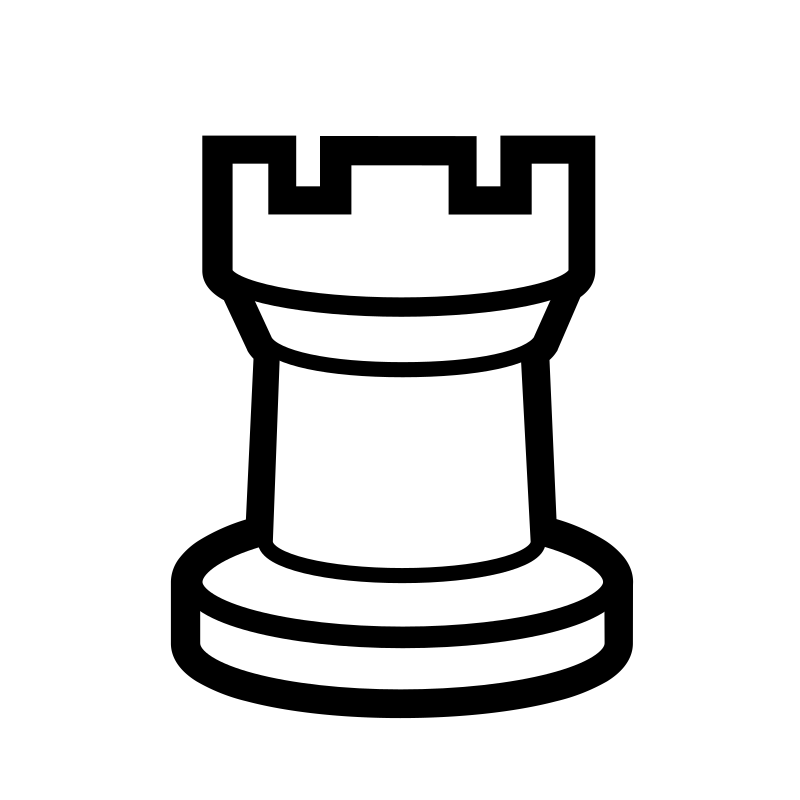
At the start, the rooks stand in the corners: White’s on a1 and h1, Black’s on a8 and h8.
Moving and capturing
The rook moves in straight lines: forwards, backwards or sideways, as far as the path is clear.
If one of its own pieces is in the way, it stops before it. It can capture an opponent’s piece in the way.
Special rules
The rook castles together with the king. This is explained under the king.
Value
A rook is worth about 5 pawns.
 Bishop
At the start, the white bishops are on c1 and f1, and the black bishops on c8 and f8.
Moving and capturing
The bishop moves diagonally, as far as the path is clear.
That is why it always stays on squares of the same colour. Each side has a bishop for the light squares and one for the dark squares.
Value
A bishop is worth about 3 pawns, the same as a knight.
 Knight
At the start, the white knights are on b1 and g1, and the black knights on b8 and g8.
Moving and capturing
The knight jumps in an L-shape: two squares in a straight line, then one to the side.
It is the only piece that can jump over other pieces. It always lands on a square of the other colour.
Value
A knight is worth about 3 pawns, the same as a bishop.
 Pawn
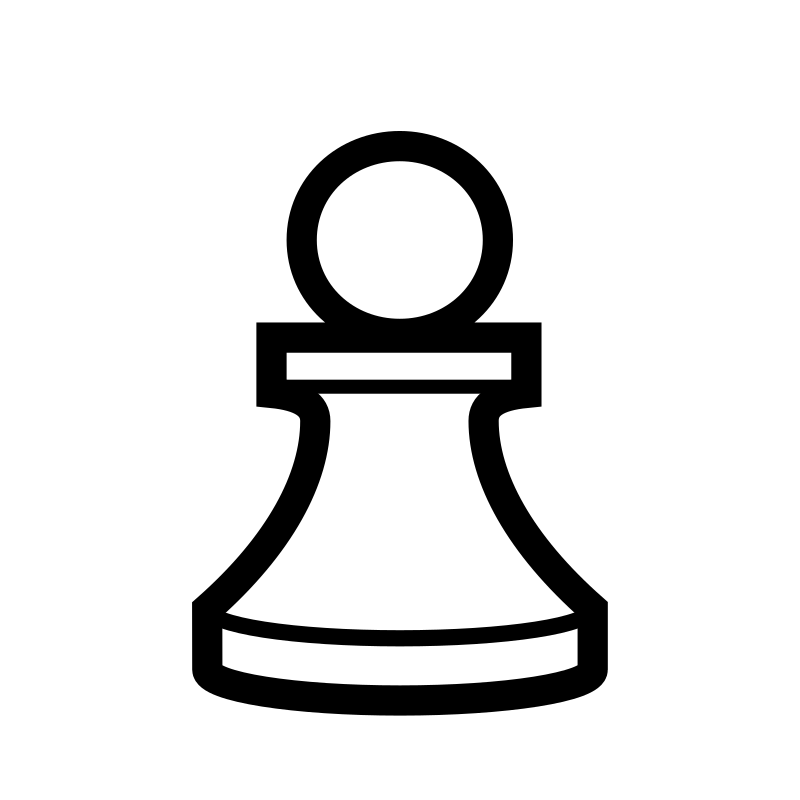
At the start, the white pawns are on the second rank and the black pawns on the seventh rank.
Moving and capturing
The pawn moves one square straight forwards. It never moves backwards.
If it is still on its starting square, it may move two squares at once.
It captures differently from the way it moves: one square diagonally forwards. If a piece is directly in front of it, it cannot go any further.
Special rules
En passant: if an opponent’s pawn advances two squares and lands right next to your pawn, you may capture it diagonally immediately, as if it had only moved one square.
Promotion: when a pawn reaches the last rank, it becomes a queen, rook, bishop or knight. Usually you choose a queen.
Value
A pawn is the smallest unit: it counts as 1.
How to write down moves
Moves are written with the piece’s letter and the square it moves to: K for king, Q for queen, R for rook, B for bishop, N for knight. For a pawn, only the square is written, for example e4.
An x means “captures”: Bxh6 means the bishop captures on h6. A + means check. O-O is castling on the kingside, O-O-O on the queenside.
Important words
- attack
- A piece attacks an opponent’s piece if it could capture it. So a pawn attacks diagonally forwards, not straight ahead.
- control
- A piece controls a square if it could capture there, even if the square is empty. If an opponent’s piece moves there, the piece controlling the square attacks it.
- protect
- A piece protects one of its own pieces if it could recapture should that piece be taken.
- exchange
- Both sides capture a piece in turn. If you give up as much as you receive, you have made an exchange.
- check
- The king is under attack. If you are in check, you must get out of check on your next move.
- checkmate
- The king is in check and cannot escape. The game is over.
- opening
- The beginning of the game: both sides bring their pieces into play.
- minor piece
- This means a knight or bishop. They are worth less than a rook or queen.
- back rank
- The rank where the king, queen, rooks, bishops and knights stand at the start: the first rank for White, the eighth rank for Black.