Chess terms from A to Z
Read a short explanation and try the idea in a related lesson. The letters take you straight to each section.
A
Absolute pin
In an absolute pin, the pinned piece may not move in a way that leaves its own king in check. In a relative pin, another piece stands behind it, usually the queen; moving away may be legal but can cost material.
Example: In lesson 13 the black knight on e5 is absolutely pinned: the rook on e1 aims through it at the king on e8, so it may not move and is lost after d2–d4. A rook, however, can sometimes move along the line of the pin or capture the attacker.
You can also search for: pinned to the king · pinned against the king · absolutely pinned · pin against the king · pin against the queen · partial pin · full pin · absolute pins · cannot move because of the king
Accuracy
Accuracy is a percentage shown after an online game: it shows how close your moves were to the engine’s moves. Every chess site calculates it differently, so you cannot compare values from two sites.
Example: If the report after a game shows “accuracy 85%”, most of your moves were close to the engine’s. The number does not say which idea you were missing; you only find that out by replaying the game move by move.
You can also search for: accuracy score · accuracy percentage · move accuracy · game accuracy · accuracy in percent · CAPS · CAPS2
Active king
In the endgame the king joins the fight. It heads for the centre early, because from there it can reach both sides.
Example: In lesson 23 only kings and pawns are left, and the black king already stands on e6. White therefore plays Ke2 at once, heading for the centre instead of moving a pawn first.
You can also search for: centralise the king · king activity · king walk · king march · centralised king
More on this: Active king: in the endgame the king joins the fight
Related terms
Active rook
A rook that attacks or supports a passed pawn from behind. A passive rook, on the other hand, can only defend.
Example: A training position from lesson 38: White has a passed pawn on a4, and the black rook stands on d8. With Ra3 the white rook gets behind its own passed pawn and escorts it forward.
You can also search for: passive rook · rook behind the passed pawn · rook activity · Tarrasch rule
More on this: Active rook: attacking instead of just protecting
Related terms
Activity
An active piece reaches many squares, attacks or threatens something; a passive piece stands around or only has to defend. Activity is often worth more than a pawn.
Example: In lesson 22 your knight on c2 is far back and does little: it is passive. With Nd4 it becomes active, because in the centre it reaches many squares and at the same time shields your king from the rook on d8.
You can also search for: active piece · passive piece · piece activity · active · passive · active pieces · passive position · play actively
Related terms
Adjournment
A game that was interrupted and continued later, once common at long tournaments. The player to move wrote the next move down secretly and put it in an envelope, which the arbiter opened only when play resumed; since strong chess engines exist, games are hardly ever adjourned any more.
Example: In Nimzowitsch’s day a long tournament game was adjourned after several hours and continued on another day. Until then both players were allowed to study the position at home, but the sealed move in the envelope stayed secret.
You can also search for: adjourned game · sealed move · adjourn a game · adjourning · envelope · resumption · resume the game · adjournments
Related terms
Advantage
You have an advantage when you are better placed than your opponent, for example with more material, a safer king or more active pieces. An advantage can be slight (“a little better”), clear or decisive; even a big advantage still has to be converted.
Example: In Jacobsen – Nimzowitsch, Copenhagen 1923 Black is clearly better after 22.e4, according to Nimzowitsch. But an advantage can also slip away again: in Brinckmann – Nimzowitsch, Bad Niendorf 1927, according to Nimzowitsch, 16…c5 at once would have held on to the advantage better than the move played, 16…Qd7.
You can also search for: edge · slight advantage · clear advantage · decisive advantage · slightly better · clearly better · upper hand · better position · disadvantage · advantages
Related terms
Analysis board
An analysis board lets you try out moves for both sides without playing a game. Online an engine is usually built in; for learning it is better to think for yourself first and ask the engine only afterwards.
Example: On every game page of the course you start your own analysis from any move with “Analyse it yourself”; your moves are then listed under “Your analyses”, and the game itself stays unchanged. You switch on the engine only when you want to.
You can also search for: analysis boards · analysis · analysis mode · computer analysis · Analyse it yourself · Your analyses · own analysis · analyse a position · analyse the game
Related terms
Arbiter
The arbiter makes sure the rules are followed at a tournament: they rule on illegal moves, check draw claims and set the clocks. If you need them, you stop your clock and call them instead of arguing with your opponent.
Example: Your opponent has pressed the clock without moving, and you disagree about what applies. You stop the clock, raise your hand and calmly explain to the arbiter what happened; they decide.
You can also search for: chess arbiter · tournament director · tournament arbiter · International Arbiter · IA · FIDE arbiter · referee · call the arbiter · arbiters
Related terms
Arena
An arena is an online tournament with a fixed duration instead of a fixed number of rounds: as soon as your game is over, you get the next opponent straight away. Whoever has collected the most points at the end wins; some sites give extra points for several wins in a row.
Example: Nimzowitsch’s tournaments such as Carlsbad 1923 had fixed rounds, and everyone played everyone. In an arena, by contrast, you play blitz for an hour, for example, as many games as fit into that time.
You can also search for: arena tournament · arena tournaments · arenas · online arena · blitz arena · arena points
Related terms
Armageddon
An Armageddon game is a final deciding game that cannot end in a tie: White gets more thinking time, but a draw counts as a win for Black. It is played when the score is still level after all other playoff games.
Example: After two rapid games and two blitz games the score is still level, so Armageddon follows: White gets, for example, 5 minutes and Black only 4, but a draw is enough for Black. So White has to win and plays for an attack, while Black may play carefully.
You can also search for: Armageddon game · Armageddon chess · Armageddon blitz · Armageddon tiebreak · deciding game
Related terms
Attack
A piece attacks an enemy piece if it could capture it. Attacked does not mean lost: check protection, piece values and the number of attackers and defenders.
Example: In lesson 5 the white knight on d5 attacks three black pieces at once: the rook on c7, the queen on e7 and the rook on f4. That is why before every move you ask: what is my opponent attacking, and is it protected?
You can also search for: attacking · attacked · attacker · attacks · attack a piece · attacked piece · under attack · aim at · take aim · hit a piece
Related terms
Attacking f2 or f7
At the start the pawn on f7 (f2 for White) is protected only by the king, which makes it a favourite target for the bishop, queen and knight. Check such attacks carefully: a calm developing move often fends them off, and castling brings the king to safety.
Example: After 1.e4 e5 2.Bc4 the bishop is already aiming at f7; in lesson 10, after castling, your rook on f1 also aims at f7 along the f-file. In lesson 14, however, 5.Nxf7+ would be a mistake: the king simply takes the knight with 5…Kxf7.
You can also search for: attack on f7 · attack on f2 · weak point f7 · the f7 pawn · sacrifice on f7 · bishop on c4 · attack on the uncastled king · protect f7 · Fried Liver attack
Related terms
Attraction
In an attraction you force an enemy piece, usually the king, onto a square where it then walks into your net. Often a sacrifice serves as bait: the piece captures it and then stands exactly where you want it.
Example: In Réti – Tartakower, Vienna 1910 (lesson 14) White lures the king to d8 with 9.Qd8+: Black has to capture (9…Kxd8). Right there the double check 10.Bg5+ strikes, and after 10…Kc7 comes 11.Bd8 mate.
You can also search for: decoy · decoy sacrifice · lure · luring the king · attraction sacrifice · magnet · bait · drawing the king out · attractions
Related terms
Average centipawn loss
The average centipawn loss tells you how much engine evaluation you lost per move on average; a centipawn is one hundredth of a pawn. The smaller the number, the closer you were to the best moves, but a single blunder pushes it up sharply.
Example: If you lose 0.3 pawn units per move on average in a game, your average centipawn loss is 30. Today many chess sites show accuracy in percent instead of this number or next to it.
You can also search for: ACPL · centipawn loss · mean centipawn loss · centipawn · centipawns · cp · evaluation loss per move
B
Back rank
The back rank is the rank where your pieces stand at the start: rank 1 for White, rank 8 for Black. The king usually still stands there, which is why an unprotected back rank is dangerous.
Example: In lesson 12 your rook stands on the seventh rank, right in front of the black back rank with the king. Check your own back rank too: if an enemy rook breaks in there and your king has no escape behind its pawns, mate is threatened.
You can also search for: home rank · first rank · last rank · eighth rank · back row · rank 1 · rank 8 · own back rank · opponent’s back rank · back ranks
Related terms
Back-rank mate
A rook or queen gives check on the back rank, and the king cannot escape because its own pawns stand in front of it. That is why it pays to give the castled king an escape square or to protect the back rank.
Example: In lesson 3 the white rook gives check on e8. The black king on g8 is shut in by its own pawns on f7, g7 and h7 and has no free square: back-rank mate.
You can also search for: back rank mate · back-rank checkmate · back-rank weakness · back-row mate · mate on the back rank · weak back rank · corridor mate · back-rank mates
Related terms
Backward pawn
A pawn that has stayed behind the pawns next to it and cannot advance safely, because an enemy pawn controls the square in front of it. No pawn of its own side can protect it any more, and the square in front of it is often a good spot for an enemy piece.
Example: Nimzowitsch – Tarrasch, Breslau 1925: the black pawn on g7 stands behind the pawn on h6, and the f-pawn is gone. If it goes to g6, the white pawn on h5 captures it; so White attacks it with 29.Rg4 and wins it later.
You can also search for: backward pawns · pawn left behind · backward · lagging pawn · pawn that cannot advance
Battery
Two long-range pieces stand one behind the other on the same file, rank or diagonal and aim at the same target, for example queen and rook or queen and bishop. The front piece can capture or advance, and the rear piece protects it or recaptures.
Example: Sämisch – Nimzowitsch, Copenhagen 1923: after 22…Raf8 23.Kh1 R8f5 both black rooks stand on the f-file, one on f5 and the other already on f2. Together with the bishop on d3 this rook battery ties White down so completely that Sämisch resigned after 25…h6.
You can also search for: batteries · rook battery · queen and rook battery · queen and bishop battery · Alekhine’s gun · pieces lined up · line up queen and rook
Related terms
Berserk
Berserk is a choice at the start of an arena game: you halve your own thinking time and in return get an extra point if you win. Your opponent keeps their full time, so berserk only pays off if you play safely and fast.
Example: If the arena is 3 minutes plus 2 seconds, after berserk you have only one and a half minutes left, and the 2 seconds per move are gone. If you still win, the win counts one point more; if you lose on time, the risk was too big.
You can also search for: go berserk · berserking · berserk mode · berserk button · half the thinking time
Related terms
Bishop pair
Both bishops of the same side. Together they reach squares of both colours.
Example: In lesson 41 the white bishop on c4 aims at f7 and the bishop on c3 at g7. After Qg4 Black has to play g6, and then Qd4 threatens mate on h8.
You can also search for: two bishops · Horwitz bishops · the two bishops · paired bishops · Harrwitz bishops · raking bishops
More on this: Bishop pair: two bishops for both colours
Blitz
Blitz is a game with at most 10 minutes of thinking time per player, increment included, for example 3 minutes plus 2 seconds. It is fun for practising patterns, but longer games are better for learning new ideas.
Example: With 3 minutes plus 2 seconds you have hardly more time for the whole game than you need for a single move in a long game. That is why the patterns you learned in this course help you in blitz: you recognise them instead of calculating.
You can also search for: blitz chess · blitz game · blitz games · speed chess · fast chess · blitz tournament · blitzing · 3 + 2 · five-minute game
Related terms
Blockade
A piece stands directly in front of an enemy pawn and stops it.
Example: Nimzowitsch – Salwe, Carlsbad 1911: after 12.Bxe5 the white bishop blockades the black pawn on e6, which can no longer advance. When Black later exchanged the blockading piece on e5, the next one took over at once with 19.Bxe5.
See it on the board

Our own teaching example
The white knight on d3 stands directly in front of the black pawn on d4. The pawn cannot move straight ahead to d3. You must also check whether the knight can stay there.
Black to move
White: Kh2, Nd3. Black: Kh8, Rd8, d4.
You can also search for: stop a pawn · hold up a pawn · block a pawn · square in front of the pawn · blockading · blockaded
More on this: Blockade
- A knight stops the pawn
- The right piece stops the pawn
- A blockade does not hold by itself
- Find more about “Blockade”
Related terms
Blockader
The piece that stands in front of the enemy pawn. Nimzowitsch called it the “Blockeur”.
Example: In lesson 33 (Nimzowitsch against Nilsson, 1924) the white rook on a5 stands directly in front of the black pawn on a6. This blockader also ties the black rook on a7 to defending the pawn, and the other white rook is free to attack.
You can also search for: blockeur · piece in front of the pawn · stopper · elasticity · blockading piece · blocker
Related terms
Blunder
A blunder is a gross mistake that often decides the game at once, for example when you leave a piece to be taken or overlook a checkmate. In comments it gets two question marks (??); if you check before every move what your opponent is attacking, you avoid many blunders.
Example: Lesson 5 shows how you avoid a typical blunder: before every move you check what your opponent is attacking and whether it is protected. In Nimzowitsch – Ahues, Berlin 1928 Nimzowitsch calls 9…f5 a serious mistake that gives up the whole centre, and two moves later he considers the game decided.
You can also search for: howler · blunders · to blunder · blunder a piece · double question mark · gross error · oversight · avoid blunders
Related terms
Book draw
A book draw is a position, usually an endgame, that ends in a draw with best play from both sides; you can find such positions in endgame books. Its counterpart is the book win: a position that can be won safely with the right technique.
Example: White has king and a-pawn, Black only the king: if the black king stands on the corner square a8, it is a book draw, because White cannot drive it out of the corner, and the attempt often ends in stalemate. King and rook against king, on the other hand, is a book win: lesson 6 shows how you checkmate the king on the edge.
You can also search for: theoretical draw · dead draw · theoretically drawn · book win · theoretical win · drawn position · drawn endgame · drawn with best play
Related terms
Book move
An opening move that is in the books because many players have tested and played it; the knowledge about this is called theory. A move played for the first time is a novelty.
Example: In Yates – Nimzowitsch, London 1927 the move 2…Nf6 was not yet a book move: Nimzowitsch himself had introduced this novelty years earlier in San Sebastián. Today the move is in every opening book, and the variation bears his name.
You can also search for: theory · opening theory · theoretical move · novelty · theoretical novelty · main line · sideline · opening book · book moves
Related terms
Breakthrough
A pawn move or pawn sacrifice that breaks open a locked pawn position and opens the way forward for a pawn. Often this creates a passed pawn, even if you give up a pawn for it.
Example: Tartakower – Nimzowitsch, London 1927: with 50…f4 Black breaks through, even though White can capture the pawn. After the exchange on f4 the white pawn on e3 is gone, and the black pawn on e4 is a passed pawn.
You can also search for: pawn breakthrough · breakthrough sacrifice · break through · breakthroughs · breaking through
Related terms
Brilliant move
A brilliant move shows a surprisingly strong or beautiful idea, often a sacrifice. Two exclamation marks express the annotator’s judgement; an especially beautiful game may receive a brilliancy prize.
Example: In Yates – Nimzowitsch, Carlsbad 1923 Nimzowitsch gives 31…Rxe5 two exclamation marks: Black gives up the rook for knight and pawn and then attacks the white king with the queen. The game received a first brilliancy prize.
You can also search for: brilliant · brilliancy · brilliancy prize · beauty prize · two exclamation marks · double exclamation mark · brilliant moves · brilliant sacrifice
Building a bridge
When building a bridge, your rook steps between your king and the checks of the enemy rook, so that your king can come out from in front of its own pawn. Nimzowitsch calls the square where the king is then safe its “hiding place”.
Example: In “My System” Nimzowitsch shows this position: White has the king on g8, a pawn on g7 and the rook on e2, Black the king on d7 and the rook on h1. After 1.Re4 Rh2 2.Kf7 Rf2+ 3.Kg6 Rg2+ 4.Kf6 Rf2+ 5.Kg5 Rg2+ the rook steps between the white king and the black rook with 6.Rg4, the bridge is built, and White wins.
You can also search for: build a bridge · bridge-building · bridge · bridge method · hiding place for the king
Related terms
Bullet
Bullet is the fastest form of online chess: usually 1 or 2 minutes per player for the whole game, as UltraBullet even just 15 seconds. Here the hand counts more than the head; bullet is of little use for learning.
Example: With 1 minute and no increment you have less than 2 seconds per move for 40 moves. Whoever blunders a piece in bullet rarely has time to notice; that is why you practise chess better with longer thinking time.
You can also search for: bullet chess · bullet game · bullet games · ultrabullet · one-minute chess · one-minute game · 1 + 0
Related terms
Bye
You get a bye when no opponent is left for you in a round, for example with an odd number of participants. You do not play in that round and usually receive a full point for it, as for a win; the tournament regulations decide this.
Example: With 15 children, one of them is left without an opponent in every round and gets the bye; in the Swiss system it usually goes to someone from the lower part of the standings, and nobody gets it twice. You do not play in that round, but the point counts in the standings.
You can also search for: byes · pairing-allocated bye · full-point bye · half-point bye · free round · no opponent · sitting out a round
Related terms
C
Candidate
The pawn of a pawn majority that has no enemy pawn in front of it on its file. It has the best chance of becoming a passed pawn, so it moves forward first.
Example: In lesson 31 White has the pawns on f2, g2 and h2 on the kingside against g7 and h7. Only the pawn on f2 has no black pawn in front of it: it is the candidate and moves forward first.
You can also search for: the candidate goes first · Mr Candidate · antagonist · candidate pawn · candidate passed pawn · the candidate
More on this: Candidate: the pawn that leads the majority
Related terms
Candidate move
A move that looks possible at first glance and that you examine more closely. First you collect two or three candidate moves, then you calculate them one after the other instead of sticking with your first idea.
Example: In lesson 15 you have three candidate moves: capture on f6, capture on b3 or retreat the bishop on g5. You look at each one briefly and then calculate only the best one carefully.
You can also search for: candidate moves · possible moves · compare moves · move selection · Kotov · find the best move · shortlist of moves
Related terms
Capture
Capturing means taking an enemy piece off the board: your piece moves onto its square, and the captured piece is out of the game. In notation this is shown by an x, for example exd5.
Example: In lesson 2 your bishop on c1 captures the knight on h6: it moves via d2, e3, f4 and g5 onto its square, and the knight leaves the board. The pawn on e4 captures differently from the way it moves: not straight ahead to e5, but diagonally to d5.
You can also search for: take · taking · takes · captures · capture a piece · take a piece · captured · x in notation · remove from the board
Related terms
Castling
A special move of king and rook: the king moves two squares to the side, and the rook moves to the other side of the king, right next to it. With the rook on h1 or h8 it is called castling kingside (O-O), with the rook on a1 or a8 castling queenside (O-O-O).
Example: In the game Nimzowitsch – Salwe, Carlsbad 1911, White castles kingside on move 8: the king moves from e1 to g1, the rook from h1 to f1. Black castles kingside later too.
You can also search for: castle · short castling · long castling · kingside castling · queenside castling · castles · castling short/long · artificial castling · castling by hand · O-O · 0-0 · O-O-O
Related terms
Castling rights
The right to castle later in the game. You lose it for good as soon as your king has moved, and for a rook as soon as that rook has moved or been captured; being in check, however, does not take your castling rights away.
Example: In lesson 4 you check before castling whether the king or the rook has already moved. If your king goes from e1 to e2 and back to e1 on the next move, it is back in place, but the castling rights are gone.
You can also search for: right to castle · castling right · lost the right to castle · can still castle · can no longer castle · castling possible · castling no longer possible · forfeit castling
Related terms
Centralisation
You bring a piece closer to the middle: knights, bishops and the king reach more squares there and can quickly help on the left or the right. Bring the king there only in the endgame.
Example: In lesson 22 your knight stands on c2 and does little. With Nd4 it comes to the middle and shields your king from the rook on d8; after that the king follows to d3.
You can also search for: centralise · centralization · centralise a piece · centralised piece · decentralisation
More on this: Endgame strategy: centralisation and active pieces
- Improve your worst piece
- The king becomes active
- A plan over several moves
- Find more about “Centralisation”
Related terms
Centre
The squares in the middle of the board, above all d4, e4, d5 and e5.
Example: In lesson 8 the game begins, and with 1.e4 you place a pawn on a central square. 1.d4 occupies the middle too; both moves take squares away from your opponent.
You can also search for: middle · middle of the board · central squares · center · expanded centre · control of the centre
More on this: Centre: the four squares in the middle
- Why the middle of the board matters
- Answer in the centre
- The leap into the centre
- Find more about “Centre”
Related terms
Centre pawn
A centre pawn is a pawn on the d-file or the e-file. Centre pawns occupy the middle and take squares away from the enemy pieces; Nimzowitsch asks for special respect for them.
Example: In lesson 8 you play 1.e4 or 1.d4 and so place a centre pawn in the middle. In My System Nimzowitsch advises, in effect, capturing an enemy centre pawn whenever that is possible without serious risk, because a pawn in the centre is usually worth more than one on the edge.
You can also search for: centre pawns · central pawn · center pawn · pawn in the centre · d-pawn · e-pawn · king’s pawn · queen’s pawn
Check
An enemy piece attacks the king. If you are in check, you must end it with your next move: move the king away, capture the attacking piece or put a piece in between.
Example: In lesson 3 White gives check with 3.Bb5+ after 1.e4 e5 2.Nf3 d6: the bishop attacks the king on e8 along the diagonal. Black must do something about it at once, for example put a piece in between.
You can also search for: give check · be in check · king attacked · in check · checking · get out of check · block the check
Related terms
Checkmate
The king is in check and cannot get out of it. Whoever is checkmated has lost the game.
Example: In lesson 3 the black king is in the corner on a8, the white king on b6 and the white queen on d7. Qd8 is checkmate: the king is in check and has no free square left.
You can also search for: mate · give checkmate · win the game · lose the game · mating · mated · checkmated
Related terms
Checkmate pattern
A checkmate pattern is a typical mating position in which you remember how the pieces work together. If you know many patterns, you spot much faster where a checkmate is possible in your own games.
Example: Well-known checkmate patterns are the back-rank mate from lesson 3, Scholar’s mate and the smothered mate. In lesson 6 you practise two more: the mate with king and rook and the mate with king and queen on the edge of the board.
You can also search for: mating pattern · mate pattern · mating motif · typical mating position · checkmate patterns · learn mating patterns · well-known mates
Related terms
Chess clock
A double clock with two displays: only the time of the player whose move it is runs. After your move you press your side of the clock with the same hand you moved with; that completes your move, and your opponent’s time runs.
Example: You move the knight with your right hand and then press the clock with your right hand. If you do not press it, your time keeps running while your opponent thinks in peace.
You can also search for: clock · chess clocks · press the clock · hit the clock · double clock · digital clock · stop the clock · start the clock · clock is running
Related terms
Chess Olympiad
At the Chess Olympiad, teams from FIDE member federations play on four boards under the Swiss system, in either an open or a women’s tournament. It usually takes place every two years and is not part of the Olympic Games.
Example: A team win scores 2 match points and a draw scores 1. If teams have the same number of match points, the tie-breaks set out in the tournament regulations decide their order.
You can also search for: Olympiad · Olympiads · chess Olympiads · FIDE Olympiad · team Olympiad · tournament of nations
Related terms
Chess960
Chess960 is a chess variant in which the pieces on the back rank are placed at random before each game; there are 960 possible starting positions, and Black mirrors White. The bishops always stand on squares of different colours, and the king stands between the rooks so that castling remains possible.
Example: Opening moves learned by heart do not help in Chess960, because every game starts differently. But what you learn in lessons 7, 8 and 10 still applies: bring all your pieces into play, mind the centre and bring your king to safety.
You can also search for: Chess 960 · Fischer Random · Fischer Random Chess · Fischerandom
Related terms
Classical
In classical chess, the starting time plus the increments for 60 moves totals at least 60 minutes per player. This gives you more time than in rapid or blitz to think about plans and calculate variations.
Example: With 90 minutes plus 30 seconds per move a game often lasts three to four hours. You can read the position calmly, as you practise in this course: look first, then decide, then move.
You can also search for: classical chess · classical game · classical games · classical time control · standard chess · long game · slow chess · long time control · tournament game
Related terms
Clearance
In a clearance you free a square or a line that one of your own pieces needs, often by moving the piece that is in the way with a threat or by sacrificing it. Unlike a deflection, you clear your own pieces out of the way, not enemy pieces.
Example: In Nimzowitsch – Marshall, New York 1927 White sacrifices a pawn with 22.f5 so that the bishop on e3 can reach g5 across the vacated square f4. A quiet clearance move appears in Réti – Nimzowitsch, Marienbad 1925: 19…Re8 frees the square f8 for the knight.
You can also search for: clearance sacrifice · vacating sacrifice · clearance move · clearing a square · clearing a line · vacate a square · clear the way · line clearance · square clearance
Related terms
Colour complex
All the squares of one colour taken together, for example the light squares. If you have lost the bishop of that colour and your pawns stand on the other colour, your opponent can occupy these squares one by one.
Example: In Brinckmann – Nimzowitsch, Kolding 1923 Black conquers the light squares one by one. After 23.Bxc4 the white bishop that controlled these squares has been exchanged, and the black pieces occupy a whole colour complex with Rc4, Rb3 and Qa6.
You can also search for: complex of squares · weak colour complex · squares of one colour · weak light squares · weak dark squares · colour weakness · square colour · colour complexes
More on this: Colour complex: weak squares of one colour
Combination
A forced sequence of moves, usually with a sacrifice, at the end of which you have a clear advantage: mate, a gain of material or a position in which you are clearly better. Your opponent has no good choice, because each of their replies has been calculated in advance.
Example: Wendel – Nimzowitsch, Stockholm 1921: with 33…Rxe2 Black gives up a rook, after 34.Kxe2 Qxg2+ the queen chases the white king across the board with checks and wins the rook back with 38…Qxh4. In the end Black has two pawns more, and Nimzowitsch considers White lost.
You can also search for: combinations · combine · tactical shot · tactical blow · forced sequence · forcing sequence · sacrificial combination · combinative play
Compensation
Compensation is what you get in return for a drawback, usually for material you have given up: an attack, active pieces, open files or weaknesses in your opponent’s camp. If it is enough, the position is equal or even better despite having less material.
Example: In Tarrasch – Nimzowitsch, Hamburg 1910 White has lost a pawn after 18…Nc6, but according to Nimzowitsch the bishop pair, the open g-file and the hanging pawns promise attacking chances: that is White’s compensation. In Nimzowitsch – Duras, San Sebastián 1912 White is ready, with 18.Nd4, to give up the pawn on b4 for the centralisation of the white pieces; according to Nimzowitsch this brave move saves the almost lost game.
You can also search for: comp · compensate · compensation for the pawn · compensation for the material · sufficient compensation · positional compensation · enough compensation
Related terms
Connected passed pawns
Two passed pawns on files right next to each other. They protect one another as they advance and are therefore very strong; a single piece can hardly stop both of them.
Example: Nimzowitsch – Spielmann, Stockholm 1920: after 47.b5 White has passed pawns on a3 and b5 on adjacent files, and no black pawn can stop them any more. Black blockades with the knight on b6, but White drives it away with 49.Nc4, and the b-pawn runs on to b7.
You can also search for: connected passers · two connected passed pawns · passed pawn pair · connected passed pawn · passed pawns side by side
Connected pawns
Pawns of the same colour on files right next to each other. They can protect one another and so hold together; a pawn without such a neighbouring pawn is isolated.
Example: In lesson 20 the white pawns on d4 and e5 stand on adjacent files, and the pawn on d4 protects the pawn on e5. That is why Black does not attack the protected pawn on e5 but plays c7–c5 against the base on d4.
You can also search for: connected · pawns next to each other · pawns on adjacent files · linked pawns · pawns that protect each other · connected pawn
Related terms
Correspondence chess
In correspondence chess the opponents do not play at the same board but send each other their moves, formerly by postcard, today through a server; you have several days for each move. You may think in peace and set up the position on a board, which is why correspondence chess is a good way to learn plans.
Example: Online you start a correspondence game with three days of thinking time per move and make one move every evening. A game then lasts several weeks, but you have as much time for each decision as you would otherwise have for a whole game.
You can also search for: correspondence · correspondence game · correspondence games · postal chess · daily chess · chess by post · days per move
Related terms
Counterplay
Active chances for the side that is worse off or defending: your own threats instead of just waiting. Counterplay forces the attacker to think about their own position too.
Example: In te Kolste – Nimzowitsch, Baden-Baden 1925 Black is worse by today’s standards, but Nimzowitsch does not sit and wait: with 16…g5 and 19…f4 he sets his kingside pawn majority in motion. So Black gets counterplay and in the end even an attack.
You can also search for: counter chances · counterattack · counter-attack · active defence · defend actively · create counterplay · counter play
Related terms
Cross-check
You get your king out of check with a move that also checks the opposing king. This can happen by blocking the check, capturing or moving your king to reveal a check.
Example: A teaching position: your king stands on e8, the white king on d1, and White gives check along the diagonal with Qa4+. You put your queen in between from h3 to d7, and because from there it attacks the white king along the d-file, that is check as well: a cross-check.
You can also search for: cross-checks · counter check · check answered by check · answer a check with a check · checking out of check · counter-checks
Related terms
D
Dead position
A position in which neither side can checkmate the enemy king any more, however play continues. The game is drawn at once, for example with king against king or king and knight against king.
Example: You only have king and bishop left, your opponent only the king. A bishop alone can never checkmate, so the game is drawn at once, even if your opponent still has 10 minutes on the clock and you only 10 seconds.
You can also search for: insufficient material · not enough material · bare king · no mate possible · king against king · draw by insufficient material · dead positions
Deflection
In a deflection you lure or force an enemy piece away from an important task, for example from protecting a piece or a square. You often give up material for this, because afterwards nobody carries out that task any more.
Example: In Nimzowitsch – Marshall, New York 1927 the black queen on d8 protects the knight on f6. With 28.Re8 White attacks the queen and deflects it: after 28…Qxe8 it can no longer protect the knight, and 29.Qxf6+ wins it with check.
You can also search for: deflection sacrifice · deflect · deflecting a defender · drive a defender away · draw a piece away · deflection motif · deflections · distraction
Related terms
Desperado
A piece that is lost anyway still captures as much as possible first or gives itself up with check. Instead of saving it, you get the most out of it, sometimes even a stalemate.
Example: A teaching position: your knight on a8 is trapped, because the black rook on b8 attacks it and its squares b6 and c7 are occupied by pawns that the pawn on a7 and the king on c8 protect. Instead of simply losing it, you still take a pawn with Nxb6 before axb6 removes it.
You can also search for: desperado piece · desperadoes · desperado move · doomed piece · piece that is lost anyway · take what you can · desperado sacrifice
Related terms
Development
Bringing pieces from their starting squares into play.
Example: In lesson 7, after 1.e4 e5 2.Nf3 Nc6 3.Bc4 Bc5, White has brought the knight on f3 and the bishop on c4 into play. The knight on b1 and the bishop on c1 are still waiting on their starting squares and come next.
You can also search for: bring out the pieces · get the pieces into play · start of the game · develop · developing move · undeveloped
More on this: Development
Diagonal
A diagonal is a slanting line of squares that all have the same colour. Bishops and the queen move along diagonals; the two longest ones, a1–h8 and h1–a8, are called the long diagonals.
Example: In lesson 2 your bishop on c1 captures the knight on h6: it runs along the diagonal c1–h6 via d2, e3, f4 and g5. If one of your own pieces stands on a diagonal, the bishop gets no further, because it cannot jump.
You can also search for: diagonals · long diagonal · great diagonal · diagonal line · diagonally · bishop’s diagonal · slanting line · a1–h8 diagonal · main diagonal
Related terms
Diagram
A diagram is the picture of a position as it appears in books and magazines: a drawn board with the pieces on it. It usually says who is to move, and often you are meant to find the solution without moving the pieces.
Example: Every lesson of the course shows you the position on a board; in a book that would be a diagram. Lesson 27 mentions that diagram 162 in My System shows the position after 12… Nb4 from Nimzowitsch – Taubenhaus, St Petersburg 1914.
You can also search for: diagrams · position diagram · picture of the position · board picture · chess diagram · position in a book · illustration · drawn board · printed position
Related terms
Discovered attack
A piece moves away and opens the line for one of your own pieces behind it, which now attacks an enemy piece. If the moving piece also gives check or makes a threat of its own, your opponent cannot deal with both.
Example: Your bishop on d3 stands in front of your rook on d1; the black king on g8 is tucked in behind its pawns on f7, g7 and h7, and the queen stands on d6. With Bxh7+ the bishop captures with check, and at the same time the rook on d1 attacks the queen on d6: Black must get out of check first and loses the queen.
You can also search for: discovered attacks · uncovered attack · attack by discovery · piece moves away and uncovers an attack · discovered threat · unmasking an attack
Related terms
Discovered check
A piece moves away and opens the way for another piece to the enemy king. Your opponent must get out of check first.
Example: Lesson 14 shows a trap in the Petroff Defence: 1.e4 e5 2.Nf3 Nf6 3.Nxe5 Nxe4 4.Qe2 Nf6 5.Nc6+. The knight moves away from e5, the queen on e2 gives check along the e-file, and at the same time the knight attacks the queen on d8.
You can also search for: discovery · piece moves away and gives check · uncovering
Related terms
Domination
Domination means that one piece controls all the squares an enemy piece could move to, so that piece has no safe move left. The term comes from endgame studies; a dominated piece can often be rounded up at leisure afterwards.
Example: A teaching position: a black knight on h1 can only move to f2 or g3. A white bishop on e1 controls both squares on the same diagonal, so the knight cannot move without being captured.
You can also search for: dominate · dominated piece · dominating · dominate a piece · domination of a piece
Related terms
Double attack
One move attacks two targets at once, either with one piece (a fork) or with two pieces, for example in a discovered attack. Because your opponent has only one move, they can often deal with only one of the two threats.
Example: In lesson 14 White attacks twice after 5.Nc6+: the queen on e2 gives check, and the knight on c6 threatens the queen on d8. Black must get out of check first and then loses the queen.
You can also search for: twofold attack · two targets at once · two attacks in one move · two threats at the same time · double attacks · attack twice
Related terms
Double check
Two pieces give check at the same time. Then only a king move helps.
Example: Réti – Tartakower, Vienna 1910 (lesson 14): after 10.Bg5+ the bishop on g5 and the rook on d1 give check at the same time. The black king has to move, and after 10…Kc7 comes 11.Bd8 mate.
You can also search for: two pieces give check · check from two pieces · double-check
Related terms
Doubled pawns
Two pawns of the same colour on the same file, one in front of the other. They cannot protect each other and find it hard to move forward.
Example: Johner – Nimzowitsch, Dresden 1926: after 7…Bxc3 8.bxc3 White has pawns on c3 and c4 on the same file. The pawn on c3 cannot protect the pawn on c4, and the black pawn on c5 holds both of them up.
You can also search for: doubled pawn · two pawns on one file · doubled isolated pawns
More on this: Doubled pawns: two pawns on one file
Related terms
Draw
A draw means the game is tied: neither side wins, and each gets half a point. A game is drawn by stalemate, by agreement, by repetition of the position, by the fifty-move rule or when nobody can checkmate any more.
Example: In lesson 3 the game ends in stalemate: the side to move is not in check and has no legal move. That is a draw, and both players get half a point.
You can also search for: drawn game · drawn · half a point · half-point · tie · tied game · split the point · the game is drawn · draws
Draw by agreement
Both players agree to end the game as a draw. You offer a draw by making your move, saying “draw?” and then pressing the clock; your opponent may accept or simply keep playing.
Example: After 30 moves both sides have only a king, a rook and three pawns left, and neither side has a useful attacking plan. You offer a draw, your opponent accepts, and each player writes down half a point.
You can also search for: draw offer · offer a draw · accept a draw · decline a draw · agreed draw · agree a draw · grandmaster draw · short draw · draw offers
Related terms
Dynamism
Dynamism means everything in a position that is in motion: piece activity, threats and attack. Its counterpart is statics, the lasting features such as pawn structure and safe squares.
Example: In Tarrasch – Nimzowitsch, Hamburg 1910 White opens the diagonal b2–f6 for the attack with 27.d5: Nimzowitsch calls this dynamism. He himself would have chosen statics, that is the quiet set-up with 27.Bb2, Qf3 and the rooks on the c- and d-files.
You can also search for: dynamic · dynamic play · dynamic balance · dynamic factors · statics · static · static advantages · dynamics and statics
Related terms
E
Elasticity of the blockader
A good blockader stands in front of the enemy pawn but stays mobile and threatens to switch to another part of the board when needed. Nimzowitsch calls this springiness elasticity; a rigid blockader, by contrast, is only a guard.
Example: In lesson 33 (Nimzowitsch against Nilsson, 1924) the white rook on a5 blockades the pawn on a6 and ties the rook on a7 to its defence. But it stays ready to switch to the f-file when needed, and exactly this readiness is its elasticity.
You can also search for: elastic blockader · mobile blockader · blockader stays mobile · springiness of the blockader · blockader threatens to leave · blockade elastically
More on this: Elasticity: staying mobile instead of going rigid
Related terms
Elo rating
The Elo rating is a number for playing strength, named after its inventor Arpad Elo; FIDE keeps it worldwide for tournament games. If you beat a player with a higher number, your Elo goes up a lot; if you lose to a weaker one, it drops a lot.
Example: Nimzowitsch is often given a historical Elo rating of 2780; it was calculated afterwards, because there was no Elo rating in his time. Today the best players in the world have over 2700 points; a player who has only just started tournaments is far below that.
You can also search for: Elo · Elo points · Elo number · FIDE rating · FIDE Elo · international rating · Elo system
Related terms
En passant
If an enemy pawn makes a double step (two squares at once) and lands right next to your pawn, your pawn may capture it diagonally as if it had moved only one square. This is only allowed on the very next move.
Example: In lesson 4 a white pawn stands on e5, and Black plays d7–d5, a double step that lands right next to it. White captures in passing with exd6 and lands on d6, the square the black pawn jumped over.
You can also search for: in passing · capture in passing · double step · e.p. · en passant capture
Endgame
The endgame is the last phase of the game, when only a few pieces are left on the board. Now the king itself becomes a fighter, and the pawns want to run towards promotion.
Example: In lesson 38 you see an endgame from Becker – Nimzowitsch 1925: White has an extra bishop, Black two extra pawns, and the active rook decides. In lesson 23 the king itself marches forward, because in the endgame hardly any piece can still attack it.
You can also search for: ending · end game · endings · endgame phase · final phase · endgame technique · few pieces left · endgame knowledge · reaching the endgame
Related terms
Engine
An engine is a chess program that calculates a huge number of positions and gives each one a number. It finds very strong moves but does not explain why a move is good; understanding it is still up to you.
Example: On every game page you can switch on the engine under “Analyse it yourself”; it shows an evaluation and the best continuation. It does not tell you whether a move fits your plan, so it is best to think for yourself first.
You can also search for: chess engine · chess program · chess computer · computer · engines · engine move · computer move · Stockfish
Related terms
Engine evaluation
The engine evaluation is a number in pawn units: +1.0 means White stands about as well as if a pawn up, a minus is good for Black, and 0.0 means equal. A human judges a position with words and plans; the engine’s number only shows what it finds within its search depth.
Example: In your own analysis on the game pages the engine shows, for example, “Evaluation: +1.2 (White is better)”. The course turns the number into words: below 0.3 it says “roughly equal”, from 1.0 “is better”.
You can also search for: engine eval · computer evaluation · evaluation by the engine · eval bar · evaluation bar · search depth
Related terms
Equality
Equality means that both sides are equally well placed: neither has an advantage. Whoever stood worse and catches up has reached equality; for Black that is often already a good aim in the opening.
Example: In Nimzowitsch – Brinckmann, Kolding 1923, according to Nimzowitsch, Black would probably have reached equality with 30…e5; he played 30…Bg6, and White won later. In Spielmann – Nimzowitsch, San Sebastián 1911 Nimzowitsch writes after 16…Ba6 that the game is level.
You can also search for: equal position · reach equality · equal game · balanced position · balance · level position · equal chances · the game is level
Related terms
Evaluation
With an evaluation you say who is better placed and why: you compare material, the safety of the kings, the pawn structure and how active the pieces are. People evaluate in words or with signs such as = (equal) and ± (White is clearly better); an engine shows a number that does not explain the why.
Example: In Tartakower – Nimzowitsch, London 1927 the game is about equal after 11…exd5, but Nimzowitsch already sees small advantages for Black in the centre. Evaluations can change: in Brinckmann – Nimzowitsch, Berlin 1927 Nimzowitsch thought castling instead of 18…Kf8 was wrong, but by today’s analysis it was even slightly better.
You can also search for: assessment · assess the position · evaluate the position · evaluation symbols · positional assessment · who is better · judge the position · evaluations
Related terms
Exchange
Both sides capture one piece each, one after the other; a good exchange has a reason, for example removing a defender. In English, “the exchange” can also mean giving a rook for a bishop or knight, but here it simply means trading pieces.
Example: In lesson 15 the black knight on f6 defends the square h7. White offers an exchange with Bxf6: if Black takes back, this defender is gone and Qh7 is checkmate.
You can also search for: trade · trading pieces · exchange pieces · remove the defender · swap · trading down · exchange variation
More on this: Exchange: when a trade pays off
Related terms
Exchange sacrifice
In an exchange sacrifice you give up a rook for a knight or bishop on purpose. In return you get something else, for example an attack, a strong square or a healthier pawn structure.
Example: In Yates – Nimzowitsch, Carlsbad 1923 Black gives up the rook for knight and pawn with 31…Rxe5; after that the black queen attacks the white king, and Black won. Nimzowitsch gave the move two exclamation marks: the exchange sacrifice brings an attack instead of material.
You can also search for: exchange sac · sacrifice the exchange · give up the exchange · positional exchange sacrifice · rook for knight sacrifice · rook for bishop sacrifice · accept the exchange sacrifice · exchange sacrifices
Related terms
F
Fair play
Fair play means playing honestly: without an engine, without outside help and with respect for your opponent. Online, chess sites check games for engine help and close accounts that cheat; in a tournament the arbiter looks after it.
Example: Whoever secretly asks an engine while solving an exercise in the course mainly cheats themselves: the solution is right, but the pattern stays unlearned. If you get help with “Show hint” instead, that is allowed, and your status honestly shows “Solved with help”.
You can also search for: fairplay · cheating · cheater · cheat detection · cheat detected · engine help · engine assistance · anti-cheating
Related terms
Fianchetto
You move the g-pawn or b-pawn one step forward and place the bishop behind it, on g2 or b2; for Black it is the same on g7 and b7. From there the bishop works along the long diagonal right into the centre.
Example: In Rubinstein – Nimzowitsch, Marienbad 1925 White sets up his bishops with 4.Bg2 and 8.Bb2, Black his with 4…Bb7 and 7…Bg7. All four bishops are fianchettoed and look along the long diagonals towards the centre.
You can also search for: to fianchetto · fianchettoed bishop · fianchetto bishop · bishop on g2 · bishop on b2 · double fianchetto · fianchetto set-up · fianchettos
Related terms
FIDE
FIDE is the world chess federation; the letters stand for Fédération Internationale des Échecs. It sets the laws of chess, keeps the Elo list, awards titles such as grandmaster and runs world championships and Olympiads.
Example: FIDE was founded in Paris in 1924, during Nimzowitsch’s lifetime; today it is based in Lausanne. Its laws apply in tournaments all over the world, including a youth tournament near you.
You can also search for: International Chess Federation · World Chess Federation · Fédération Internationale des Échecs · world chess body · FIDE rules · FIDE Laws of Chess
Related terms
Fifty-move rule
If each side has made 50 moves without a pawn move or a capture, the player to move may claim a draw. After 75 such moves by each side, the game is automatically drawn, unless the last move delivers checkmate: then checkmate takes precedence.
Example: With king and rook, you can drive the opposing king to the edge and checkmate it there. Take care not to lose your rook or cause stalemate.
You can also search for: 50-move rule · fifty moves · 50 moves · 75-move rule · seventy-five-move rule · draw after fifty moves · moves without pawn move or capture · fifty move rule
Related terms
File
A file is a vertical column of eight squares, running from bottom to top; the files are named a to h. The horizontal lines are called ranks instead, and rooks love files without pawns.
Example: In lesson 1 you learn the e-file: it runs from e1 to e8, and both kings stand on it at the start. In lesson 11 a file without pawns is called an open file; there a rook works across the whole board.
You can also search for: files · a-file · e-file · d-file · h-file · rook file · column · vertical line · letters a to h · vertical
Related terms
Flag-fall
Your thinking time has run out before you made the required moves: you lose the game, even if nothing was lost on the board. Only if your opponent could not checkmate you by any series of moves does the game end in a draw.
Example: Your clock shows zero and your opponent still has a queen and a rook: you have lost on time. But if they only have their king left, the game is a draw, because nobody can checkmate with a king alone.
You can also search for: flag · flag fall · losing on time · lose on time · win on time · flagging · to flag someone · out of time · time forfeit · clock at zero
Related terms
Fool’s mate
Fool’s mate is the shortest checkmate of all: White pushes two pawns in front of the king, and the black queen gives mate on move two. It hardly ever happens in real games, but it shows how important it is to keep the king safe.
Example: Fool’s mate arises after 1.f3 e5 2.g4 Qh4 mate. The queen attacks the king on e1 along the diagonal h4–e1; White cannot put anything in between, and the king has no free square.
You can also search for: fools mate · two-move checkmate · shortest mate · fastest mate · mate after two moves · f3 and g4 · Qh4 mate
Related terms
Fork
One piece attacks two or more enemy pieces at the same time with a single move. Your opponent can usually save only one of them, and you capture the other.
Example: In lesson 21 the black knight on b4 threatens Nc2+, a fork against the king on e1 and the rook on a1. In Nimzowitsch – Romi, London 1927 the move 26.Nc7+ attacks the king on e8 and the rook on a8 at the same time; after 26…Kd8 comes 27.Nxa8.
You can also search for: knight fork · pawn fork · family fork · royal fork · queen fork · bishop fork · attack two pieces at once · forks
Related terms
Fortress
A fortress is a defensive position that your opponent cannot break open despite having more material. If you manage to build a fortress, you hold the draw even with less material.
Example: A teaching position: White has the king on c3 and the queen on d5, Black only the king on h7, a pawn on g7 and the rook on f6. As long as the rook stands on the sixth rank and is protected by the pawn on g7, the white king cannot get past the fifth rank, and despite queen against rook the game is a draw.
You can also search for: fortresses · drawing fortress · build a fortress · positional draw · impregnable position
Related terms
G
Gambit
An opening in which you offer a pawn in order to develop faster, control the centre or attack. If your opponent takes the pawn, you have less material but have gained time.
Example: In lesson 10 a sequence of moves begins with 1.e4 e5 2.f4: White offers the pawn on f4, which is the King’s Gambit. Black does not take it but answers with 2…d5 and offers a pawn in return, a countergambit.
You can also search for: gambit play · countergambit · pawn sacrifice in the opening · gambit pawn · King’s Gambit · Queen’s Gambit · accept the gambit · decline the gambit · gambits
Related terms
Game
A game is a whole contest at chess from the starting position to the result: a win, a loss or a draw. It is divided into opening, middlegame and endgame, even though the borders between them are fluid.
Example: A short game in this course is Nimzowitsch – Alapin, St Petersburg 1914: it starts from the starting position with 1.e4 and ends after 18 moves with the checkmate 18.Re8#. The result is written 1–0 because White won.
You can also search for: chess game · games · a full game · course of the game · whole game · end of the game · game result · play a game · phases of the game
Related terms
Good and bad bishop
A bishop is bad when your own pawns stand on its colour and block its way; the other bishop, with free diagonals, is the good one. So it is often worth exchanging the bad bishop or giving it air with a pawn move.
Example: In Nimzowitsch – Salwe, Carlsbad 1911, after 12.Bxe5 the black pawns on d5 and e6 stand on light squares, just like the black bishop on d7: they are in its way, so it is a bad bishop. The white bishop on e5, on the other hand, is a good bishop: it stands safely in front of the pawn on e6, and no black pawn can attack it.
You can also search for: good bishop · bad bishop · big pawn · tall pawn · locked-in bishop · bishop behind its own pawns · good bishops · bad bishops
More on this: Good and bad bishop: bishops and pawn colours
Greek gift sacrifice
The famous bishop sacrifice on h7 against the castled king: Bxh7+ Kxh7, then Ng5+ and the queen comes to h5 or g4. It only works if your pieces follow quickly enough and the king finds no safe flight square.
Example: A teaching position from many games: White has the bishop on d3, the knight on f3 and the queen on d1, the black king stands on g8 after kingside castling behind the pawns on f7, g7 and h7, and no knight is left on f6. After 1.Bxh7+ Kxh7 2.Ng5+ Kg8 3.Qh5 White threatens Qh7 mate, because the rook on f8 takes the flight square away from the king.
You can also search for: Greek gift · classical bishop sacrifice · bishop sacrifice on h7 · Bxh7+ · Bxh7 sacrifice · sacrifice on h7 · Greek gift on h2
Related terms
H
Half-open file
A file with no pawns of your own and at least one enemy pawn. Your rook can put pressure along this file, and a piece often finds an outpost in front of an enemy pawn.
Example: In lesson 37 Black has no e-pawn left, but White still has the pawn on e4: for Black the e-file is half-open. The rook on e8 works along this file, and the knight finds a protected outpost on e5.
You can also search for: half-open files · half open file · file with enemy pawns only · half-open · pressure on the half-open file · file with an enemy pawn
Related terms
Hanging pawns
Two pawns side by side, usually on the c- and d-files, with no pawns of their own colour on the files next to them. No pawn can protect them, but they control a lot of space.
Example: Rubinstein – Nimzowitsch 1907 (lesson 35): Nimzowitsch has the pawns on c5 and d5 side by side, and no black pawn is left on the b- or e-file. If one of the two advances, the other protects it; Nimzowitsch calls this “blockaded security”.
You can also search for: hanging pawn pair · the hanging ones · hanging pawn duo
More on this: Hanging pawns: strong and vulnerable at once
Related terms
Hanging piece
A piece that is attacked and not protected. Your opponent can take it without losing anything.
Example: In lesson 5 the white bishop on g5 attacks the black rook on d8, and no black piece protects it: the rook is hanging. Black saves it by moving it away or by putting a pawn in between with f7–f6.
You can also search for: piece is hanging · unprotected piece · unprotected · en prise · hanging · loose piece · undefended piece
Having the move
The side to move is the one that has to play now; the players move in turn, and White begins. Passing is not allowed: whoever has the move must move, even if they do not like any of their options.
Example: Every exercise tells you who has the move, for example “White to move.” In lesson 21 you turn the question round: what would my opponent play if they had the move now?
You can also search for: the move · side to move · whose move is it · whose turn · your turn · it is your move · to move · moving in turn
Related terms
Hypermodernism
A movement in chess around 1920 with Nimzowitsch, Réti and Breyer: the centre is not occupied early with pawns but controlled from a distance with pieces and pawn levers. Many ideas from “My System”, such as restraint and overprotection, belong to it.
Example: Réti – Nimzowitsch, Marienbad 1925: Réti opens with 1.c4 and 2.Nf3 and lets the black pawns advance instead of occupying the centre with his own pawns. Both players belonged to the hypermodern school, which prefers to control the centre from the outside.
You can also search for: hypermodern school · hypermodern · hypermoderns · hypermodern chess · Nimzowitsch, Réti and Breyer · neo-romantic school · neo-romanticism
More on this: Hypermodernism: the chess revolution
Related terms
I
Illegal move
A move the rules do not allow, for example one that leaves your own king in check. In a tournament the position is restored and a legal move is played; the first time your opponent gets extra time, the second time you lose the game.
Example: In lesson 3 Black is in check after 1.e4 e5 2.Nf3 d6 3.Bb5+. If Black now plays 3…Nf6, the king stays in check: the move is illegal and must be taken back.
You can also search for: illegal · illegal moves · legal move · legal moves · not allowed · move against the rules · impossible move · forbidden move
Related terms
Imbalance
A difference between the two camps, for example bishop against knight, better pawns against more active pieces, or more space against more material. If you spot the imbalances, you know what to build your plan on.
Example: In Brinckmann – Nimzowitsch, Kolding 1923 Black gives a bishop for a knight with 8…Bxf3, and after 9.gxf3 White has doubled pawns. The material is equal, the position is not: White has the bishop pair, Black the healthier pawn structure.
You can also search for: imbalances · imbalanced position · asymmetrical position · unequal material · differences in the position · pluses and minuses · bishop against knight
Related terms
Inaccuracy
An inaccuracy is a move that is not the best but does little harm: the position stays tenable, just a bit less good. In comments it gets a question mark and an exclamation mark (?!); several inaccuracies, however, can add up to a real disadvantage.
Example: In Nimzowitsch – Leonhardt, San Sebastián 1911 Nimzowitsch writes about 31.exd5 that 31.cxd5 would have been more accurate; White won anyway. In Nimzowitsch – Krause, Copenhagen 1924, on the other hand, 27.Nd5 gets an exclamation mark because it is more accurate than 27.Ne6.
You can also search for: inaccurate · inaccurate move · small mistake · slight mistake · not the best move · inaccuracies · more accurate was · second-best move
Related terms
Increment
With a Fischer increment, you receive extra time for every move and can save unused seconds. Bronstein delay instead gives you a short allowance for each move that protects your main thinking time but cannot be saved up.
Example: In Fischer mode, “3 + 2” gives each player 3 minutes of starting time and 2 extra seconds for every move. If you play a move in less than 2 seconds, your time reserve grows.
You can also search for: time increment · bonus time · Fischer increment · Fischer mode · cumulative mode · seconds per move · added time · increments
Related terms
Initiative
The side with the initiative dictates what happens: its moves threaten something, and the opponent has to respond. The side with the initiative can plan, while the other side can only react.
Example: In Nimzowitsch – Leonhardt, Ostend 1907 White gives up a pawn with 6.Nxc6 and gets the initiative in return: two bishops aim at the black king, and almost every white move brings a new threat. Black can only defend and resigns after 21.Re1.
You can also search for: have the initiative · seize the initiative · take the initiative · keep the initiative · put on pressure · apply pressure · be in the driving seat
Related terms
Interference
You place a piece or pawn in the line of action of an enemy piece. This cuts off its protection of another enemy piece or pawn, or its attack on one of your own pieces or pawns.
Example: A teaching position: the black rook on a5 protects the pawn on h5 along the fifth rank, and your rook on h1 attacks that pawn. With e4–e5 (protected by the pawn on d4) you put a pawn in between, the protection is cut, and the pawn on h5 is lost.
You can also search for: interference sacrifice · cut the line · cut off the defender · interrupt the protection · blocking the defence · interferences · line interference
Related terms
Invasion of the centre
A piece, usually a knight, breaks into a square in the centre that no enemy pawn controls.
Example: In lesson 39 the middle looks closed, but no black pawn controls the square d5. Capablanca jumps with his knight from c3 to d5 and opens the position that way.
You can also search for: central invasion · jump into the centre · break into the centre
More on this: Invasion of the centre: the leap into the centre
Related terms
Isolani
A pawn with no pawns of the same colour on the files next to it. No pawn can protect it, and the square in front of it is often a good spot for an enemy piece.
Example: In lesson 27 White has an isolani on d4, and no white pawn can control the square d5 in front of it. So you put your knight right there with Nd5: no white pawn can drive it away.
See it on the board
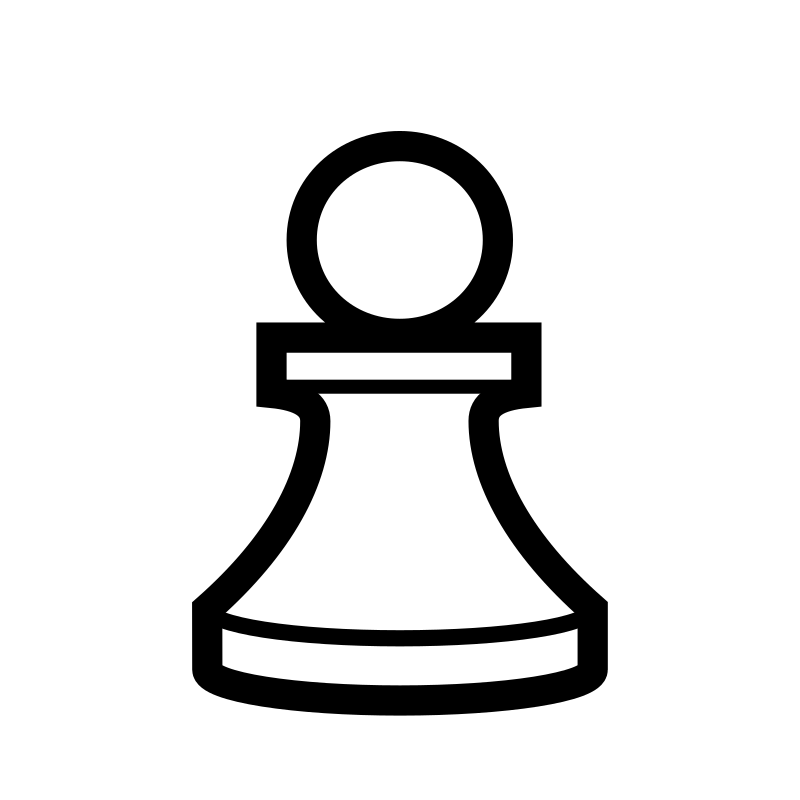
Our own teaching example
The white pawn on d4 is isolated. There is no white pawn on the neighbouring c- or e-file. Pieces can still protect it; it is not automatically lost.
White to move
White: Kg1, a2, b2, d4, f2, g2, h2. Black: Kg8, a7, b7, f7, g7, h7.
You can also search for: isolated pawn · lonely pawn · isolated queen pawn · IQP · isolated d-pawn
Related terms
Isolated pawn couple
Two pawns on adjacent files with no other pawns of their own next to them, the rear one being backward. Nimzowitsch treats it alongside the isolani: as long as the rear pawn cannot catch up, the couple is immobile and easy to blockade.
Example: In lesson 35 (a simultaneous game of Nimzowitsch’s, 1910) Black has the pawns on c6 and d5 with no pawns next to them, because there is no black pawn on the b- or e-file. The rear pawn on c6 is backward; Nimzowitsch advises c6–c5, otherwise White soon puts a knight on the square c5.
You can also search for: isolated pawn pair · isolated pawn couples · pawn couple · two isolated pawns side by side · isolated duo
More on this: Isolated pawn couple: the rear pawn must advance
Isolated queen’s pawn
An isolani on the d-file, the queen’s file: usually a white pawn on d4 with no pawns of its own on the c- and e-files. For Nimzowitsch it is a central theme: full of energy in the middlegame, often weak in the endgame.
Example: In lesson 27 (Nimzowitsch against Taubenhaus, 1914) White has an isolated queen’s pawn on d4, because there is no white pawn on the c- or e-file. The bishop on e3 protects it, just as Nimzowitsch recommends.
You can also search for: queen’s pawn isolani · isolani on the d-file · isolated pawn on d4 · lone d-pawn · isolated QP · IQP position
More on this: Isolated queen’s pawn: alone on the d-file
Related terms
J
J’adoube
By saying “j’adoube” (French for “I adjust”) you announce that you only want to straighten a piece, not move it. You may do this only when it is your move, and you say it before you touch the piece.
Example: Your bishop is sitting crooked on its square. You say “j’adoube”, move it to the middle of the square and do not have to move it afterwards.
You can also search for: I adjust · adjust a piece · adjusting · straighten a piece · centre a piece · say j’adoube
Related terms
K
Key square
In the endgame of king and pawn against king, a key square is a square that secures the win: if your king reaches it without losing the pawn, you win, no matter who is to move. That is why the kings fight for these squares first rather than for the pawn itself.
Example: With a white pawn on e4, the key squares are d6, e6 and f6. If, for example, your king is on d6 and the black king on e8, White wins even when it is White to move.
You can also search for: key squares · critical square · critical squares · key squares of the pawn · reach a key square
Related terms
Kibitzer
A kibitzer is a spectator who watches a game and makes comments or suggests moves. At a tournament this is forbidden: spectators must not interfere in a game, or the arbiter can send them out of the playing hall.
Example: At the club you watch a blitz game and call out “take the queen”; that is kibitzing, and the players are allowed to object. At a tournament you watch quietly and talk about the moves only after the game.
You can also search for: kibitz · kibitzing · kibitzers · spectator · spectators · onlooker · watching a game · commenting spectator
Related terms
Knockout
In a knockout, two players at a time play a short match against each other; the loser is out, the winner moves on to the next round, until only the champion is left. If a match is tied, a playoff with shorter thinking time follows.
Example: At the FIDE World Cup, pairs of players play two games against each other; whoever loses the match goes home. If it stands at 1:1, playoffs with rapid and blitz games follow until one of them is ahead.
You can also search for: knockout tournament · knock-out · KO · KO system · elimination · elimination tournament · playoff · play-off · tiebreak match
Related terms
L
Lead in development
You have more pieces in play than your opponent because they have lost time, for example by moving the same piece several times or by grabbing pawns. For Nimzowitsch the lead in development is the ideal of the opening; whoever has it can often attack before the opponent is ready.
Example: In lesson 9, after 1.e4 d5 2.exd5 Qxd5, White attacks the queen with 3.Nc3 and brings a piece into play at the same time; Black has to move the queen again. In the game Nimzowitsch – Alapin, St Petersburg 1914, such a lead turns into a mating attack that ends with 18.Re8#.
You can also search for: development lead · better developed · more pieces in play · development advantage · ahead in development · faster development · lead in development as an ideal
Related terms
Lever
A pawn move in which a pawn attacks an enemy pawn.
Example: In lesson 20, after 1.e4 e6 2.d4 d5 3.e5, Black plays c7–c5. The pawn on c5 attacks the pawn on d4, the base of the white chain: a lever against the foundation.
You can also search for: attack a pawn · pawn break · pawn against pawn · pawn lever · break · tension · pawn tension
Related terms
Liquidation
You exchange pieces on purpose in order to reach a simpler position that you can win or hold safely. Nimzowitsch calls this liquidating and warns against exchanging without such a reason.
Example: In Tarrasch – Nimzowitsch, Hamburg 1910 Black is a pawn up and forces the exchange of bishops with 38…Be3. What remains is an endgame with knight against bishop, in which the extra pawn is easier to convert: a liquidation.
You can also search for: simplification · simplify · liquidate · trading into the endgame · transition to the endgame · simplifying exchange · liquidations
Related terms
Lucena position
The Lucena position is the most important winning position in the endgame of rook and pawn against rook: your pawn is on the seventh rank, your king right in front of it, and your rook cuts off the enemy king. By building a bridge you bring your king out, and the pawn promotes.
Example: A teaching position: White has the king on d8, a pawn on d7 and the rook on e1, Black the king on g7 and the rook on c2; the rook on e1 cuts off the black king, and the rook on c2 holds the c-file. White to move wins with 1.Re4 and building a bridge, for example 1…Rc1 2.Ke7 Re1+ 3.Kd6 Rd1+ 4.Ke6 Re1+ 5.Kd5 Rd1+ 6.Rd4.
You can also search for: Lucena · Lucena’s position · the Lucena · Lucena positions · Lucena method
Luft
A pawn move in front of the castled king, usually h2–h3 or g2–g3, gives it a flight square against a mate on the back rank. Such a hole costs a move but can save the whole game.
Example: In lesson 3 Re8 is mate because the king’s own pawns on f7, g7 and h7 take every flight square away from the black king on g8. If the pawn already stood on h6, the king would have luft and could escape to h7.
You can also search for: flight square · escape square · make luft · give the king luft · air for the king · escape square for the king · flight squares · bolt-hole
Related terms
M
Major piece
The major pieces are the queen and the rooks, the most valuable pieces after the king. They need open files and ranks to work; in the opening they usually still stay behind the pawns.
Example: In lesson 6 you checkmate the king on the edge, once with the rook and once with the queen: with the help of the king, a major piece seals off a whole rank. In lesson 11 you learn that rooks are strongest on files without pawns.
You can also search for: major pieces · heavy piece · heavy pieces · queen and rook · rook and queen · queen and rooks · big pieces · big piece
Related terms
Manoeuvre
Several moves with one aim: a piece travels via other squares to a better square. Sometimes one of your own pieces has to make room first.
Example: In lesson 24 the black knight is to go from e7 to d6, in front of the white passed pawn on d5. First the king makes room with Kb8, then the knight goes via c8 to d6.
You can also search for: regrouping · piece manoeuvre · plan over several moves · maneuver · manoeuvring · redeployment · knight manoeuvre
Related terms
Manoeuvring against a weakness
Attacking a weakness from different sides in turn, also by attacking other targets, until the defence can no longer keep up. The target stays the same weakness.
Example: In lesson 29 the white rook first attacks the pawn on h7 from the side, along the seventh rank. Then it switches to the h-file with Rf6+ and Rh6, until the pawn on h7 falls.
You can also search for: switching the front · siege of a weakness · besiege a weakness · maneuvering · manoeuvre against a weakness · switching the attack · alternating threats
More on this: Manoeuvring against a weakness: back and forth with a fixed goal
- Attacking a weakness from two sides
- Manoeuvring along an axis
- Attack on both wings
- Find more about “Manoeuvring against a weakness”
Related terms
Mate in one
The first level of mating puzzles: you find the one move that gives checkmate at once. Each time, check whether the king really has no square left and whether the mating piece cannot be captured.
Example: In lesson 3 the black king stands on a8, the white king on b6 and the white queen on d7, and Qd8 is mate in one. Qc8, Qe8, Qb7 and Qa7 also mate at once here, only Qc7 would be stalemate.
You can also search for: mate-in-one · one-move mate · checkmate in one · mate in one move · quick mate · instant mate · find the mating move
Related terms
Mate in two
A puzzle in which you must give checkmate in two moves: your first move forces your opponent to reply, your second move is the mate. The first move is often not a check but shuts the king in or takes away its last flight square.
Example: In lesson 6 the white king stands on c6, the queen on d4 and the black king on e8; Qg7 leaves him only the square d8, and after Kd8 Qd7 is mate. With a rook instead of the queen it works like this in the same lesson: Kd6 forces Kd8, and then Rf8 is mate.
You can also search for: mate in two moves · two-mover · three-mover · mate in three · mate in three moves · two-move mate
Mate threat
The threat to give checkmate on the next move. Your opponent must do something about it at once, and often that costs them material or an important move.
Example: Nimzowitsch – Marshall, New York 1927: with 30.Bh6 White threatens Qg7 mate, and the bishop controls the mating square. Marshall resigned at once.
You can also search for: threat of mate · threatening mate · threatens mate · mating threat · mate threats · threat to checkmate · mate next move · danger of mate
Related terms
Material
Material is everything you have on the board, counted by the piece values. Whoever has more material, say an extra pawn or an extra piece, has a material advantage and can often win in the endgame.
Example: In Nimzowitsch – Jacobsen, Copenhagen 1923 White captures a pawn with 37.Rxd5 and is a pawn up afterwards. This small material advantage is enough for White to win in the end.
You can also search for: material advantage · material gain · material loss · material disadvantage · up a pawn · up a piece · a pawn up · a piece up · equal material · down a pawn
Related terms
Mating net
A mating net is a position in which all the king’s escape squares are controlled, so that it can no longer get away from checkmate. Often you weave the net move by move before you give the final check.
Example: In Nimzowitsch – Alapin, St Petersburg 1914 the black king can no longer escape after 16.Bxc6+: on 16…bxc6 comes 17.Qd8 mate. After 16…Kf8 White mates with 17.Qd8+ Bxd8 18.Re8.
You can also search for: mating nets · mating attack · net around the king · weave a mating net · build a mating net · king caught in the net · take away escape squares · closing the net
Mating technique
You drive the enemy king to the edge with a few pieces and checkmate it there. Your own king helps.
Example: In lesson 6 the black king is on e8, your king on e6 and your rook on f1. With Kd6 you leave the king only the square d8, and after Kd8, Rf8 is checkmate.
You can also search for: drive to the edge · mate on the edge · giving mate · basic checkmates · piece checkmates · elementary mates · queen mate · rook mate · bishop and knight mate
Related terms
Middlegame
The middlegame is the phase between the opening and the endgame: the pieces are developed, and most of them are still on the board. Now you need a plan, for example an attack, a better square for a piece or a weakness in your opponent’s camp.
Example: In lesson 42 you see a middlegame from Teichmann – Nimzowitsch 1911: many pieces are still on the board, and both black rooks stand on the h-file. Nimzowitsch writes, in effect, that in the middlegame the king is a mere extra, but in the endgame one of the main actors (lesson 23).
You can also search for: middle game · middlegame phase · middle of the game · middlegames · after the opening · middlegame plan · middlegame strategy · main battle
Minor piece
The minor pieces are the knights and bishops; each is worth about three pawns. In the opening you bring them into play first, because they develop quickly and are harder to chase away than the queen.
Example: In lesson 7 each side has developed two minor pieces after 1.e4 e5 2.Nf3 Nc6 3.Bc4 Bc5: a knight and a bishop. The rule of the lesson is to bring out the minor pieces first, each of them only once if possible.
You can also search for: minor pieces · minor · knight and bishop · bishop and knight · knight or bishop · light piece · light pieces · small pieces
Related terms
Minority attack
An attack with two pawns against three: you advance with fewer pawns against the opponent’s pawn majority in order to create a weakness there. The typical case is b2–b4–b5 against the pawn on c6 in the Exchange Queen’s Gambit.
Example: In Nimzowitsch – Romi, London 1927, after 6.cxd5 exd5 two white pawns (a2 and b2) face three black ones (a7, b7 and c6) on the queenside. The minority attack here would be b2–b4–b5 against the pawn on c6; in this game, however, Nimzowitsch chooses the attack in the centre with e3–e4.
You can also search for: attack with fewer pawns · queenside minority attack · b-pawn advance against c6 · minority attacks · pawn minority attack
More on this: Minority attack: the minority goes on the attack
Related terms
Mistake
A mistake is a move that clearly worsens your position but does not spoil everything yet: you lose a pawn, for example, or give away an advantage. In comments it gets one question mark (?); it weighs more than an inaccuracy and less than a blunder.
Example: In Yates – Nimzowitsch, Carlsbad 1923 Nimzowitsch calls 18.Qe3 a mistake because the queen leaves the dark diagonal f4–c7; for him 18.Rd1 was right. In Bogoljubow – Nimzowitsch, St Petersburg 1914, according to Nimzowitsch, 22.Re1 was a mistake instead of 22.Bxd5, and from then on things go downhill for White.
You can also search for: mistakes · make a mistake · bad move · error · misstep · question mark · faulty move
Related terms
Mobility
How many useful moves a piece or a group of pawns has. For Nimzowitsch this counts a great deal: pawns should stay mobile, and even a blockading piece must not freeze up.
Example: In lesson 33 your rook on a5 blockades the pawn on a6 and at the same time ties down the black rook on a7. Even so it stays mobile: if it is needed on the f-file, it may leave the blockade.
You can also search for: mobile · mobile piece · keep a piece mobile · freedom of movement · immobile · tied-down piece · room to move
Related terms
Move
A move is one action by a player: they shift one of their own pieces to another square according to the rules. In the counting, one white move and one black move together form a numbered move; a single one is also called a half-move or ply.
Example: In lesson 9 White attacks the queen on d5 with the move 3.Nc3, and Black has to move the queen away again with their third move; so White is a move ahead. The number 3 is the move number: it stands before the white move and also covers the black reply.
You can also search for: moves · half-move · ply · move number · to move a piece · make a move · move pair · full move
Related terms
Move classifications
Move classifications are the labels a chess site gives every move after the game, for example best move, good, inaccuracy, mistake or blunder. The grading depends on how much a move gives away compared with the engine move; it shows you where to look, but not why the move was bad.
Example: If the report marks three of your moves as mistakes or blunders, look at exactly these positions like a decision point in the course. Ask yourself there: what was the opponent threatening, and what did I overlook?
You can also search for: move classification · move labels · move grades · best move · excellent move · good move · move symbols · game report
Related terms
Movement of the pieces
How a piece moves: the rook moves straight, the bishop diagonally, the queen both, the king one square, the knight like an L. The pawn moves forward and captures diagonally.
Example: In lesson 2 the rook on a1, the knight on b1 and the bishop on c1 stand side by side. The rook moves straight up the a-file, the bishop diagonally to b2 or d2, and the knight jumps over everything to a3, c3 or d2.
You can also search for: how the pieces move · piece movement · moving the pieces · rules of movement · rules · knight · bishop · capturing · moves of the pieces
Mysterious rook move
A preventive rook move onto a file that is still blocked by pawns but that would be opened by a freeing pawn move of your opponent. The rook is already in place, which makes that move unattractive for them.
Example: In lesson 40 (Blackburne against Nimzowitsch, St Petersburg 1914) pawns still block the e-file, yet Nimzowitsch places a rook on it with Re8. If White later plays d3–d4, then after exd4 the white pawn on e4 stands alone on the file, right in the rook’s sights.
You can also search for: mysterious rook moves · rook on a closed file · preventive rook move · prophylactic rook move · rook move without a visible purpose · file that may open
More on this: Mysterious rook move: the rook waits for its file
Related terms
N
Norm
A norm is a tournament result at title level: in a tournament of at least 9 games you play as strongly as FIDE requires for the title, a performance rating of 2600 for a grandmaster norm and 2450 for an IM norm. For the title you need norms covering at least 27 games in total and also the required Elo rating.
Example: A young International Master plays in a 9-round open against grandmasters and other strong opponents and reaches a performance rating above 2600: that is a grandmaster norm. With norms covering at least 27 games and an Elo rating of 2500 he can apply for the grandmaster title.
You can also search for: title norm · GM norm · IM norm · grandmaster norm · norms · title result · achieving a norm
Related terms
Notation
Notation is the written form of moves: today we write algebraically, that is piece letter and destination square, for example Nf3, and for pawn moves only the square, for example e4. An x means capture, + check, # checkmate and O-O castling.
Example: In lesson 7 you see the sequence 1.e4 e5 2.Nf3 Nc6: first the move number, then the white move, then the black one. Nf3 means “the knight moves to f3”, and exd5 in lesson 9 means “the pawn from the e-file captures on d5”.
You can also search for: chess notation · algebraic notation · short algebraic notation · long algebraic notation · SAN · writing down moves · reading notation · move notation · record the moves · how to read moves
Related terms
O
Occupying the file
You place a rook or the queen on an open or half-open file so that the piece works along it and can later break in. If the second rook stands behind it, the file is usually yours; Nimzowitsch speaks of an operation on the file whose goal is to break into the seventh or eighth rank.
Example: Rubinstein – Nimzowitsch, Marienbad 1925: with 18… Rfe8 Nimzowitsch occupies the e-file although it is still closed; after 19.Bxf6 exf6 it is half-open, and the rook attacks the knight on e3. In the end the rook captures the knight with 24… Rxe3.
You can also search for: file operation · occupy the file · play on the open file · double the rooks · rooks doubled on a file · control of the file · fight for the file · rook lift
Related terms
Open and closed position
In an open position central pawns have been exchanged, files and diagonals are free, and bishops and rooks work from afar. In a closed position the pawn chains lock together, and knights and slow plans come into their own.
Example: In lesson 41 you learn that the bishop pair is strongest in open positions, because the bishops then have free diagonals. In Nimzowitsch – Leonhardt, San Sebastián 1911, by contrast, White deliberately keeps the centre closed and attacks with his pawns on the kingside.
You can also search for: open position · closed position · open game · closed game · blocked position · semi-open position · open positions · closed positions
Related terms
Open file
A file with no pawns. Rooks can use it well.
Example: In lesson 11 there are no pawns left on the d-file, but there are on every other file. With Rad1 you place a rook on it, and it works all the way to d8.
You can also search for: free file · road for the rook · activate the rook · open rook file · open lines · file opening · doubling rooks · rooks on the open file
More on this: Open file: a clear road for the rooks
Related terms
Open tournament
An open is a tournament in which everyone may take part, from beginner to grandmaster, usually under the Swiss system. Often there are several groups by rating, so that you play opponents of about your own strength.
Example: In the first round of an open a child may sit opposite a grandmaster; after that the Swiss system makes sure that opponents with similar results meet. Many clubs hold an open in summer where you can earn your first Elo rating.
You can also search for: open · opens · open event · open Swiss · playing in an open · open section
Related terms
Opening
The opening is the first phase of the game, roughly the first ten to fifteen moves. Here you bring your pieces into play, fight for the centre and bring your king to safety.
Example: In lesson 7 you see an opening after 1.e4 e5 2.Nf3 Nc6 3.Bc4 Bc5: both sides have moved a centre pawn and developed two pieces. Lessons 7 to 10 show what matters in this phase: development, the centre, tempo and king safety.
You can also search for: opening phase · openings · chess opening · first moves · opening move · opening principles · beginning of the game · opening rules
More on this: Openings named after Nimzowitsch
Related terms
Opening explorer
An opening explorer shows for a position which moves were played in many master or online games, how often and with what result. It tells you what is usual; why a move is good you still have to understand yourself.
Example: After 1.e4 c6 2.d4 d5 3.e5 Bf5 from Nimzowitsch – Capablanca, New York 1927 an opening explorer shows you which moves White plays most often here and how the games ended. Why White builds a pawn chain with its base on d4 with 3.e5 is not in the statistics; lesson 20 explains that to you.
You can also search for: opening explorers · opening database · explorer · game database · master database · opening statistics · move statistics
Related terms
Opposite castling
The two kings have castled on different sides, one kingside and one queenside. Each side then usually attacks where the enemy king stands, and a race begins.
Example: In Nimzowitsch – Duras, San Sebastián 1912 White castles kingside with 10.O-O and Black castles queenside with 12…O-O-O. After that each side attacks where the enemy king stands: White with b4–b5 on the queenside, Black with g5–g4 and the rooks on the h-file.
You can also search for: opposite-side castling · castling on opposite sides · opposite-sides castling · kings on different wings · race of attacks · castled on opposite wings
Related terms
Opposite-coloured bishops
Each side has only one bishop left, and the two move on squares of different colours. In the endgame this often leads to a draw; in the middlegame it can strengthen an attack, because the one bishop can never be stopped by the other.
Example: If White has only a bishop on the light squares left and Black only one on the dark squares, the two bishops can never touch. The black bishop can stop a white passed pawn on a dark square, and the white bishop can never drive it away; that is why such endgames often end in a draw.
You can also search for: bishops of opposite colours · bishops on different colours · bishops of different colour · unlike bishops · endgame with bishops of opposite colours · opposite bishops
Related terms
Opposition
In the opposition the two kings face each other, usually with exactly one empty square between them; whoever is not to move then “has” the opposition. The king that has to move cannot go forward and must give way, and so the other king can often get past it.
Example: A teaching position: your king is on e5, your pawn on e4 and the black king on e7, and it is Black to move, so you have the opposition. The black king must give way, and after Kd7 your king advances with Kf6, after Kf7 with Kd6; if it were White to move instead, Black would hold the draw.
You can also search for: distant opposition · direct opposition · diagonal opposition · have the opposition · gain the opposition · take the opposition · king opposition · kings facing each other
More on this: Opposition: the duel of the kings
Related terms
Outpost
An advanced piece on an open or half-open file, protected by one of your own pawns. Usually it is a knight.
Example: In the game Teichmann – Nimzowitsch, Carlsbad 1911, Black has no e-pawn left, and his rook on e8 stands on this file. Nimzowitsch puts his knight on this file with Ne5, where the pawn on d6 protects it.
You can also search for: outpost square · outpost point · outpost knight · strongpoint · support point · advanced square
More on this: Outpost: a piece with backing
Related terms
Outside passed pawn
A passed pawn far away from the other pawns, usually near the edge of the board. In an endgame it is valuable because it lures the enemy king far away from the other pawns.
Example: Picture a pawn ending: White has pawns on a4, f2, g2 and h2, Black only on f7, g7 and h7, and both kings stand in the centre. If the black king has to stop the passed pawn on a4, it is far away from its own pawns, and meanwhile the white king can attack f7, g7 and h7.
You can also search for: distant passed pawn · outside passer · outside passed pawns · far-away passed pawn · passed pawn on the wing
Overall mobility
The mobility of your pawns as a whole, not of each single pawn. According to Nimzowitsch a pawn may stay behind if it supports the others, because a mobile pawn mass can crush the opponent.
Example: Nimzowitsch – Olson, Copenhagen 1924: with 14.Nc2 White gives up the pawn on b2, but the white kingside pawns stay mobile with f4, g4 and g5, while the black pawns are held fast. Nimzowitsch writes that seven white pawns were more mobile here than eight black ones.
You can also search for: overall mobility of the pawn mass · mobile pawn mass · mobility of the pawn mass · mobile pawns · pawn mass · urge of the pawns to expand
More on this: Overall mobility: pawns as a mobile group
Related terms
Overloading
A piece is overloaded when it has several important tasks and cannot carry them all out at once. For example, it protects two pieces but can save only one after an attack.
Example: In Nimzowitsch – Alapin, St Petersburg 1914 the black bishop on e7 has two tasks after 16…Kf8: it controls d8 against Qd8 mate and blocks the e-file for the rook on e1. White exploits this with 17.Qd8+: the bishop has to capture (17…Bxd8) and clears the file; 18.Re8 is mate.
You can also search for: overloaded piece · overworked piece · overloaded defender · overload · overworked defender · too many duties · too many defensive tasks · overloading motif
Overprotection
Protecting an important point with more pieces than you need right now, even before your opponent attacks it hard. The pieces that protect it are then ready for other jobs too.
Example: Against Spielmann in Stockholm 1920, Nimzowitsch places both rooks behind the pawns on d4 and e5 with 17.Rad1 and 18.Rfe1. The queen on d2 and bishop on e2 still stand in between, so the rooks initially support the pawns’ protection indirectly.
See it on the board
Our own teaching example
The knights on d3 and f3 and the bishop on c3 protect the white pawn on e5. Only the black pawn on d6 attacks it at present. Extra protection can provide reserves, but it is useful only if the pieces also stand well for other purposes.
White to move
White: Kg1, Bc3, Nd3, Nf3, e5. Black: Kg8, d6, f7, g7, h7.
You can also search for: overprotect · overprotector · protect with several pieces · overprotecting
More on this: Overprotection: securing important points in advance
Related terms
P
Passed pawn
A pawn that no enemy pawn can stop or capture on its way forward.
Example: In lesson 16 you create a passed pawn yourself: White has a pawn on d4, Black a pawn on c5. After dxc5 no black pawn is left ahead of the pawn on c5 on the b-, c- or d-file, so it is now a passed pawn.
See it on the board
Our own teaching example
The white pawn on d5 is a passed pawn. No black pawn stands ahead of it on the d-file or the neighbouring c- and e-files. A black piece could still stop it.
White to move
White: Kg1, a2, b2, d5, g2, h2. Black: Kg8, a7, b7, g7, h7.
You can also search for: passer · pawn with a free path · pawn runs through · passed pawns · connected/protected/outside passed pawn
More on this: Passed pawn: the pawn with a free path
Pawn centre
Your own pawns on the central squares, usually d4 and e4 for White or d5 and e5 for Black. A mobile pawn centre takes squares away from the opponent; a fixed one can be besieged by the opponent’s pieces.
Example: In lesson 8 White has the pawns on d4 and e4 side by side in the centre: a pawn centre. Black attacks it at once and captures one of the two pawns with cxd4.
You can also search for: pawn center · classical centre · central pawns · pawns in the centre · mobile pawn centre · pawn centres
Pawn chain
Pawns stand diagonally one behind the other, and in front of each one stands an enemy pawn. The pawn of the chain that no other pawn of the chain protects is called the base; the one furthest forward is called the head.
Example: Nimzowitsch – Salwe, Carlsbad 1911, after 3.e5: the white pawns on d4 and e5 stand diagonally one behind the other, with the black pawns on d5 and e6 in front of them. The base of the white chain is d4, its head e5.
You can also search for: chain · base · head of the chain · base of the chain · pawn-chain · link
More on this: Pawn chain: attack at the base
Related terms
Pawn duo
Two pawns of the same colour right next to each other on the same rank. Together they control four squares in front of them, and if one advances, the other protects it.
Example: In lesson 32 the white pawns on e5 and f5 stand side by side on the fifth rank: a pawn duo. Together they control d6, e6, f6 and g6, and if one of the two advances, the other protects it.
You can also search for: duo · pawn pair · two pawns side by side · pawn duos · pawns side by side
Related terms
Pawn island
A group of pawns of the same colour on files next to each other, with no gap between them. The fewer islands you have, the better your pawns hold together and the fewer weaknesses you have to protect.
Example: In lesson 27 White has three pawn islands: a2 and b2, the single pawn on d4, and f2, g2 and h2. Black has only two, because the pawns on e6, f7, g7 and h7 hang together, and so do a7 and b6.
You can also search for: pawn islands · island · islands · pawn group · group of pawns
Related terms
Pawn majority
In one part of the board you have more pawns than your opponent, usually on one wing, for example three against two. A healthy majority can create a passed pawn.
Example: In lesson 32 White has the pawns on e5, f5, g2 and h2, while Black has only f7, g7 and h7 there: four against three. This majority in the centre stands close to the black king, which makes it especially dangerous.
You can also search for: majority · extra pawns on one wing · central majority · queenside majority
More on this: Pawn majority: more pawns on one side
- The majority in the centre
- Restraining in time
- The candidate goes first
- Find more about “Pawn majority”
Related terms
Pawn minority
You have fewer pawns than your opponent in one part of the board, for example two against three on one wing. You often use them to restrain or attack the enemy majority; whether a passed pawn can arise depends on the position.
Example: In lesson 31 Black has only the pawns on g7 and h7 on the kingside, while White has f2, g2 and h2 there: two against three, a minority. Here Black tries to restrain White’s candidate pawn on f2.
You can also search for: minority · fewer pawns · pawn minorities · minority of pawns · outnumbered pawns
Related terms
Pawn roller
Several pawns side by side that advance together and drive enemy pieces before them. Nimzowitsch considers it less dangerous than it looks: if you challenge it, you can restrain it and attack it later.
Example: Spielmann – Nimzowitsch, San Sebastián 1911: after 1.e4 c5 2.Nf3 Nimzowitsch plays 2… Nf6 and invites White to chase the knight with e4–e5. He considers such a pawn roller less dangerous than it looks; Spielmann declined to play 3.e5.
You can also search for: pawn avalanche · steamroller · roller · avalanche · advancing pawn front · pawn front · challenging the pawn roller
More on this: Pawn roller: threatening, but often vulnerable
Related terms
Pawn storm
Several pawns advance together against the enemy king, usually on the wing where it has castled. They aim to drive away the pawns in front of the king and open lines for the pieces.
Example: In Nimzowitsch – Leonhardt, San Sebastián 1911 the white pawns advance step by step against the black kingside with 8.h3, 11.g4 and 23.h4. White deliberately keeps the centre closed so that Black gets no counterplay there.
You can also search for: pawn advance · storming pawns · pawn rush · pawn attack on the king · kingside pawn storm · queenside pawn storm · pawn storms
Related terms
Pawn structure
This is the name for the position of all the pawns on the board, without looking at the pieces. Because pawns can never move backwards, the pawn structure shows where a position is strong and where it is weak.
Example: Imagine lesson 27 without the pieces: what remains are the white pawns on a2, b2, d4, f2, g2 and h2 and the black pawns on a7, b6, e6, f7, g7 and h7. This pawn structure shows White’s weakness: the pawn on d4 stands alone, and no pawn next to it can protect it.
You can also search for: pawn skeleton · pawn formation · pawn structures · pawn configuration · arrangement of the pawns
More on this: Pawn structures: what the pawns dictate
Related terms
Performance rating
The performance rating is a number worked out from your results in a single tournament: it tells how strongly you played in that tournament. If you score half the points against your opponents, it is roughly their average rating; if you score more, it is higher.
Example: Your opponents have an average of 1600 points and you score 5 out of 7. Your performance rating is then clearly above 1600, even if your own rating is only 1400 so far.
You can also search for: performance · TPR · tournament performance · tournament performance rating · Elo performance · rating performance
Related terms
Perpetual check
One side gives check again and again, and the enemy king finds no square where it is safe from the checks. Because the position keeps repeating, the game ends in a draw; this is how the side with less material often saves half a point.
Example: You are a rook down, but your queen can check the enemy king from two squares in turn, and the king only shuttles between two escape squares. Nobody can change that, so the game is a draw.
You can also search for: perpetual · endless checks · check after check · constant checks · unending check · give perpetual check · perpetual checks · saving the game with checks
Related terms
PGN / FEN
PGN is a file format for whole games: header lines with players, place and date, then the moves in notation, plus comments and variations. FEN describes a single position in one line, rank by rank from the eighth to the first, with capital letters for White and small letters for Black, plus who is to move.
Example: On every game page you save the whole game with “Download the game as PGN” and can open it in another chess program. The FEN of the starting position begins with rnbqkbnr/pppppppp/8: small letters for the black pieces and pawns on the eighth and seventh ranks, and the 8 stands for a completely empty rank.
You can also search for: PGN · FEN · PGN file · FEN string · FEN code · Portable Game Notation · Forsyth–Edwards Notation · game file
Related terms
Philidor position
The Philidor position is the most important drawing position in the endgame of rook against rook and pawn: your king stands in front of the enemy pawn, and your rook holds your third rank so that the enemy king cannot come forward. When the pawn moves onto that rank, your rook goes to your opponent’s back rank and gives check from there.
Example: A teaching position: White has the king on d5, a pawn on e5 and the rook on h7, Black the king on e8 and the rook on a6, and it is White to move. As long as the rook on a6 holds the sixth rank, the white king cannot come forward; after 1.e6 the rook goes to the back rank with 1…Ra1, gives check from there, and the game is a draw.
You can also search for: Philidor’s position · third-rank defence · third rank defence · Philidor method · Philidor positions
Related terms
Piece
Piece can mean any chessman, but in the narrower sense only the king, queen, rooks, bishops and knights, that is everything except the pawns. That is why people say “pieces and pawns” and call all 32 together the chessmen.
Example: In lesson 2 you learn how each piece moves: each side has 16 chessmen, namely 8 pawns and 8 pieces (king, queen, two rooks, two bishops, two knights). The rule from lesson 7 to bring out the minor pieces first means knights and bishops, not pawns.
You can also search for: pieces · chessman · chessmen · man · men · chess piece · chess pieces · pieces and pawns · unit · units
Piece letters
Piece letters are the abbreviations of the pieces in notation, and they differ from language to language: English K, Q, R, B, N for king, queen, rook, bishop, knight; German K, D, T, L, S; French R, D, T, F, C. Careful: the French R is the king (roi), the English R is the rook, and the pawn has no letter at all.
Example: In lesson 7 you move the knight to f3. The course writes this move with its own letter in each language, S in German, N in English, C in French; the destination square f3 always stays the same.
You can also search for: piece letter · piece symbols · piece abbreviations · letters for the pieces · K Q R B N · figurine notation · FAN · N for knight · B for bishop · piece initials
Piece values
Piece values are comparative values in pawn units that help you judge an exchange: pawn 1, knight 3, bishop 3, rook 5, queen 9. The king has no value because it is never captured, and the numbers are only a rule of thumb, since the position can change them.
Example: Lesson 5 gives the rule of thumb: pawn 1, knight and bishop 3, rook 5, queen 9. If a pawn attacks your knight, protection alone does not help, because in the exchange you would give 3 points for 1.
You can also search for: piece value · value of the pieces · values of the pieces · relative value · point value · pawn units · pawn unit · how much is a piece worth · value in pawns · point count
Related terms
Pin
A bishop, rook or queen attacks a piece and, behind it on the same line, a more important piece – usually the king or the queen. The piece in between is pinned.
Example: In lesson 13 White attacks the pinned knight on e5 with the pawn move d2–d4. Because of the rook on e1 the knight may not move away, as its king on e8 would then be in check; so the knight is lost.
See it on the board

Our own teaching example
The rook on e1 faces the king on e8, with the black knight on e5 between them. If the knight moved away, its king would be in check. This knight therefore has no legal move.
White to move
White: Kg1, Re1, Bc1, a2, b2, c3, d2, f2, g2, h2. Black: Ke8, Ra8, Ne5, a7, b7, c7, d6, f7, g7, h7.
You can also search for: pinned · pinned piece · piece cannot move · to pin · pinning · relative pin · cross-pin · unpin
More on this: Pin: tied down and free again
Related terms
Plan
A plan is a goal that your next moves serve, for example a better square for a piece. With a plan you do not just move somewhere; every move has a purpose.
Example: In lesson 24 the goal is clear: the knight belongs on d6, right in front of the white passed pawn. The route takes three moves: first the king makes room with Kb8, then the knight goes via c8 to d6.
You can also search for: game plan · planning · to plan · playing without a plan · goal and route · make a plan · find a plan · plans
Related terms
Point of attack
The enemy pawn that you advance your pawns against in order to open the file next to it. Nimzowitsch takes the word from Tarrasch: the point of attack is the target that an operation on a file aims at.
Example: In “My System” Nimzowitsch shows a position in which the black pawn on h6 is the point of attack: White plays h3, g4 and g5, and after hxg5 a piece recaptures. The g-file next to the point of attack is now open, and the rook on g1 works along it.
You can also search for: target of attack · object of attack · target pawn · pawn as target · opening a file against a pawn · attacking point
More on this: Point of attack: a pawn as a target
Related terms
Poisoned pawn
A pawn you could capture but that would cost you dearly: the capturing piece gets trapped, loses time or opens lines for your opponent. Before you take a pawn that seems free, you check why your opponent is giving it away.
Example: Nimzowitsch – Alapin, St Petersburg 1914: with 9…Qxg2 the black queen grabs a pawn while the other black pieces are still at home. In return White gains time, brings piece after piece into play and mates with 18.Re8#.
You can also search for: poisoned pawns · poisoned piece · poisoned · Poisoned Pawn Variation · pawn grab · pawn grabbing · greedy capture · take the pawn or not
Related terms
Positional play
Playing for small, lasting advantages such as better squares, safe pawns and more space rather than for quick combinations. For Nimzowitsch positional play is above all prevention: you stop your opponent’s freeing moves and overprotect your strong points.
Example: In lesson 21 (Wendel against Nimzowitsch, Stockholm 1921) Nimzowitsch meets the threat of Nb5 with 6… a6 rather than 6… f5, because he may need the square b5 later and does not want to show his cards too early. Such preventive moves without a direct attack are for him the heart of positional play.
You can also search for: position play · play positionally · positional player · positional advantages · slow play · playing for small advantages · positional chess
More on this: Positional play: preventing instead of just attacking
Related terms
Post-mortem
After a tournament game the two opponents often sit down together and look at the game again: what was each of them thinking, where was the mistake, what would have been better? This joint analysis is called a post-mortem and is one of the best chances to learn, because you find out what your opponent saw.
Example: You have lost and feel annoyed, but in the analysis room your opponent shows you why they did not take the rook. With the scoresheet you replay the game, and you write down the moment where you want to decide differently next time.
You can also search for: postmortem · post-mortem analysis · post-game analysis · joint analysis · going over the game · analysing the game together · analysis room
Related terms
Premove
A premove is a move you enter online while your opponent is still thinking; as soon as they have moved, your move is played at once if it is legal then. It saves valuable time in bullet and blitz, but it is dangerous when the opponent plays something unexpected.
Example: You expect your opponent to capture your knight on e5, so you enter the recapture as a premove. If they play something else, your move is dropped if it is no longer legal, or it is played and may be a blunder.
You can also search for: premoves · pre-move · pre-moves · premoving · move in advance · enter a move in advance
Related terms
Promotion
When a pawn reaches the last rank, it becomes a queen, a rook, a bishop or a knight. Usually you choose a queen.
Example: In lesson 4 your pawn stands on e7, one square from its goal. With e8=Q it reaches the last rank and becomes a queen.
You can also search for: promote a pawn · queen a pawn · reach the last rank · promote · promoting · queening · promotion square
Related terms
Prophylaxis
You stop a plan or a good move of your opponent before they can play it. To do this, ask yourself before your move: What does my opponent want?
Example: In the game Wendel – Nimzowitsch, Stockholm 1921, the white knight on c3 wants to go to b5 and attack the pawn on c7 from there. Nimzowitsch plays the quiet move a6 and takes the square away before it gets dangerous.
You can also search for: prevention · prevent · preventive move · what does my opponent want · prophylactic · prophylactic move · what does my opponent want?
More on this: Prophylaxis: what does your opponent want?
Related terms
Protected passed pawn
A passed pawn that one of its own pawns protects. The opponent cannot simply capture it with a piece, and their king must always keep an eye on it.
Example: Nimzowitsch – Brinckmann, Kolding 1923: after 20.c6 no black pawn is left in front of the white pawn on c6, and the pawn on b5 protects it. Black can hold this passed pawn up with pieces but cannot win it, because any piece that captures it is lost to the pawn on b5.
You can also search for: protected passer · defended passed pawn · supported passed pawn · protected passed pawns · passed pawn protected by a pawn
Related terms
Protection
A piece is protected when one of your own pieces could recapture if your opponent takes it. Protection makes capturing expensive for your opponent, but it does not protect against an attacker that is worth less.
Example: In lesson 5 the white bishop on b5 attacks your knight on c6. The knight is protected, because the pawns on b7 and d7 could recapture; still, you check whether you like the exchange.
You can also search for: protect · protected · defend · defended · defender · cover · covered · protected piece · guard · guarded · defend a piece
Related terms
Puzzle
A tactics puzzle is a position for practice in which there is one clearly best sequence of moves, usually winning material or giving checkmate. Online puzzles have their own rating, which goes up with every solved puzzle and down with every wrong one.
Example: The exercises in this course are partly tactical, partly strategic: in lesson 14 you win material with a discovered check, in lesson 18 you choose the piece that holds a blockade most safely. A tactics puzzle usually has exactly one solution, a strategic exercise often several good answers.
You can also search for: puzzles · tactics puzzle · tactical puzzle · chess puzzle · daily puzzle · puzzle of the day · tactics problem · puzzle rating
Related terms
Puzzle Rush
Puzzle Rush is a game mode on a large chess site: you solve as many puzzles as possible in 3 or 5 minutes, or without a clock until you have made three mistakes. The puzzles get harder and harder, and other sites have similar modes under their own names.
Example: Under “Practise” the course has no clock and no limit on mistakes: “Five minutes today” brings one review, one new idea and a short wrap-up, and you can stop at any time. A Puzzle Rush, by contrast, trains quick recognition of patterns that you have first learned calmly.
You can also search for: Puzzle Battle · Puzzle Storm · Puzzle Streak · Puzzle Racer · Survival · streak · puzzles against the clock
Related terms
Puzzle themes
Puzzle themes are the groups into which online puzzles are sorted, for example fork, pin, skewer, discovered attack, intermediate move, mating patterns or endgames. If you choose a theme, you practise the same pattern in ever new positions.
Example: The themes are named like many terms in this glossary: if you choose the theme pin online, you practise the same pattern as in lesson 13, only in many different positions. Start with a theme you already know from the course.
You can also search for: puzzle theme · tactics themes · tactical themes · puzzle motifs · motifs · puzzles by theme · choose a theme · endgame puzzles
Related terms
Q
Qualitative majority
A pawn majority that comes not from the number of pawns but from their mobility: your pawns stand further forward or advance more easily than the enemy pawns. Nimzowitsch demands that such a majority, too, be restrained in time.
Example: In lesson 34 (Nimzowitsch against Bernstein, Carlsbad 1923) both sides have the same number of pawns on the kingside. Because the black pawn on e4 stands further forward than the white pawn on e3, Nimzowitsch still counts the black pawns as a majority and restrains them in time.
You can also search for: qualitative pawn majority · majority of an ideal nature · mobile majority · majority without extra pawns · equal pawns, more space · chain majority
More on this: Qualitative majority: the same number of pawns, unequal strength
Related terms
Questioning
You attack an active enemy piece, such as a pinning bishop or an outpost, with a pawn or a less valuable piece and force it to decide: capture, retreat or stay. Nimzowitsch warns that questioning with wing pawns can loosen your own position.
Example: Nimzowitsch – Leonhardt, San Sebastián 1911: the black bishop on h5 pins the knight on f3 to the queen on d1. After 9.Bg5 and 10.Bxf6 Nimzowitsch questions the bishop with 11.g4, and it has to retreat to g6; the pawns on h3 and g4 are later used for the attack.
You can also search for: question a piece · to question · challenge a piece · put the question to the bishop · force the piece to decide · drive away with a pawn · question the doubled pawns
More on this: Questioning: driving away the pinning bishop with a pawn
Quiet move
A move without check, without capture and without an open threat that still decides the game: it prepares something or takes away the opponent’s last way out. Quiet moves are hard to find because the eye looks at the loud moves first.
Example: Sämisch – Nimzowitsch, Copenhagen 1923 ends with the quiet move 25…h6: no check, no capture, no new threat, and yet White resigned. Nimzowitsch writes that the move declares zugzwang; by today’s standards White was already lost before that.
You can also search for: quiet moves · silent move · move without check or capture · subtle move · unassuming move · calm move · preparatory move · hidden threat
Related terms
R
Rank
A rank is a horizontal row of eight squares; the ranks carry the numbers 1 to 8, counted from White’s side. White starts on ranks 1 and 2, Black on 7 and 8.
Example: In lesson 1 you look for the square e4: it lies on the e-file and on rank 4. In lesson 12 a rook breaks into the seventh rank, where the black pawns still stand on their starting squares.
You can also search for: ranks · row · rows · horizontal line · numbers 1 to 8 · fourth rank · fifth rank · rank 4 · horizontal
Related terms
Rapid
Rapid is a game with more than 10 and less than 60 minutes of thinking time per player, increment included. There is time to think, but not for long calculations.
Example: A game with 15 minutes and a 10-second increment per player is rapid. Do not take too much time in the opening, so that minutes are left in the endgame for the important decisions.
You can also search for: rapid chess · rapidplay · rapid game · rapid games · rapid play · active chess · quick chess · rapid tournament
Related terms
Rating
A rating shows in a single number how strongly someone plays: the higher, the stronger. FIDE uses Elo, Germany has the DWZ, and online platforms mostly use Glicko-2; so numbers from different systems cannot be compared directly.
Example: Online you get a separate rating for blitz, rapid and puzzles. It changes a little after every game; at the start it swings a lot, because the platform first has to find out how strong you are.
You can also search for: ratings · rating points · rating number · playing strength · Glicko-2 · Glicko · online rating · rating system
Related terms
Removing the defender
An enemy piece protects a square or a piece that you want to attack; so you first capture that defender or exchange it. Afterwards the target is unprotected, and your attack goes through.
Example: In lesson 15 the black knight on c6 controls the square d8. White captures this defender with Nxc6: if the pawn takes back (bxc6), Rd8 is mate, and otherwise White is a piece up.
You can also search for: removing the guard · remove the guard · capture the defender · removal of the defender · eliminate the defender · exchange the defender · undermining · take away the protection
Related terms
Resignation
A player who resigns declares the game lost before being checkmated; the opponent gets the full point. Many players tip over their king or shake hands to do so, but you never have to resign: as long as you see a chance, you may play on.
Example: Nimzowitsch – Ahues, Berlin 1928: after 36.Re5 Black resigned. Instead of playing on until checkmate, Ahues accepts that the position is lost and ends the game himself.
You can also search for: resign · resigns · resigned · resigning · give up the game · tip over the king · concede the game · throw in the towel
Related terms
Restrain, blockade, destroy
Nimzowitsch’s three steps against mobile enemy pawns: first you stop them from advancing, then you place a piece directly in front of them, and only at the end do you attack the pawns that are held fast and win them. The order matters, because a pawn that can still move is hard to attack.
Example: Rubinstein – Löwenfisch, Carlsbad 1911 (lesson 25) carries Nimzowitsch’s motto “First restrain, then blockade and finally destroy!” (our translation). In the course you practise restraining in lesson 34 and blockading in lessons 17 to 19.
You can also search for: first restrain, then blockade, finally destroy · restrain, blockade and destroy · restrict, blockade, destroy · three steps of the blockade · blockade formula · first restrain, then blockade
Related terms
Restraint
You stop enemy pawns from advancing by controlling the squares in front of them, even before you blockade them. For Nimzowitsch, restraint is the first step in the fight against a mobile pawn majority.
Example: In lesson 34 (Nimzowitsch against Bernstein, Carlsbad 1923) White restrains the black kingside pawns with Nh4, g3, Ng2 and h4, before they can set off with f5, g5 and f4. Later the restraint thickens into a blockade with Nf4.
You can also search for: restrain · restriction · restrict · hemming in · hold back the pawns · prevent the pawn advance · restrained pawns · restraining
More on this: Restraint: stopping pawns from advancing
Rook endgame
A rook endgame is an endgame in which each side has only rooks left besides the king and pawns. It is the most common kind of endgame, and the more active rook often decides.
Example: In lesson 38 each side has a rook and four pawns: your rook on b6 attacks the pawns on a6 and g6, while the black rook on a7 has to protect the pawn on a6 and stands passively. As so often in rook endgames, the active rook has the advantage.
You can also search for: rook endgames · rook ending · rook endings · rook and pawn against rook · rook and pawn endgame
Related terms
Round-robin
In a round-robin everyone plays everyone, once, or twice in a double round-robin, once with White and once with Black. The number of rounds is fixed in advance, and the result is especially fair because all players had the same opponents.
Example: Carlsbad 1929, Nimzowitsch’s greatest success, was a round-robin: every master played every other, and at the end Nimzowitsch finished ahead of Capablanca, Spielmann and Rubinstein. In a club tournament with eight children a round-robin needs seven rounds.
You can also search for: round-robin tournament · all-play-all · everyone plays everyone · double round-robin · single round-robin · round-robins
Related terms
Rule of the square
With the rule of the square you can see without long calculation whether a king catches a passed pawn without outside help: imagine a square from the pawn up to its promotion square and just as wide to the side. If the king stands inside it or can step into it on its move, it catches the pawn; if the pawn is still on its starting rank, the square begins one rank further up because of the double step.
Example: A teaching position: your pawn is on b4, your king far away on h1 and the black king on g4. If it is Black to move, the king steps into the square b4–b8–f8–f4 with Kf5 and catches the pawn; if it is White to move, the square gets smaller with 1.b5, and the king comes too late.
You can also search for: square of the pawn · pawn square · square rule · square of the passed pawn · enter the square
Related terms
S
Sacrifice
A sacrifice gives up material on purpose in order to get something else in return: an attack on the king, time, open files or a strong square. A sham sacrifice wins the material straight back, while a real sacrifice relies on an advantage that lasts.
Example: In Nimzowitsch – Alapin, St Petersburg 1914 White gives up a bishop with 14.Bf6 to open the d-file and attack with check; four moves later Black is checkmated. In Brinckmann – Nimzowitsch, Kolding 1923 Black sacrifices only a pawn with 19…b5 so that the white bishop on d3 can be exchanged.
You can also search for: sac · to sacrifice · piece sacrifice · pawn sacrifice · queen sacrifice · bishop sacrifice · sham sacrifice · pseudo-sacrifice · positional sacrifice · accept the sacrifice
Related terms
Scholar’s mate
Scholar’s mate is a checkmate on f7 (or f2) with queen and bishop after only a few moves. Recognising the threat and developing your pieces is more important than setting the trap.
Example: The best-known sequence is 1.e4 e5 2.Qh5 Nc6 3.Bc4 Nf6 4.Qxf7 mate. Black fends off the attack with 3…g6, and after 4.Qf3 the move 4…Nf6 blocks the white queen’s path to the pawn on f7.
You can also search for: scholars mate · four-move checkmate · four-move mate · defend against Scholar’s mate · Qh5 and Bc4 · queen and bishop attack · mate in four moves
Scoresheet
The sheet on which you write down every move by you and your opponent at a tournament, move by move in notation. It lets the arbiter check a repetition or the fifty-move rule later, and lets you replay the game at home.
Example: The game from lesson 3 begins like this on the scoresheet: 1.e4 e5 2.Nf3 d6 3.Bb5+. Each move goes on a new line: White’s move on the left, Black’s on the right.
You can also search for: score sheet · game score · notation sheet · writing down the moves · recording the moves · keep score · scoresheets · electronic scoresheet
Related terms
Seventh rank
The rank right in front of your opponent’s back rank, where their pawns stand at the start. For White it is the seventh rank, for Black the second rank.
Example: In lesson 12 you bring your rook along the open d-file to the seventh rank with Rd7. There it attacks the pawns on b7 and f7 from the side; if the black king protects f7, you capture with Rxb7.
You can also search for: 7th rank · rook on the seventh · rook breaks in · the seventh · absolute seventh rank · pigs on the seventh · blind pigs · second rank
More on this: Seventh rank: breaking into the enemy camp
Related terms
Sharp / solid
A position or move is called sharp when it carries a lot of risk for both sides: the pieces attack, material is often sacrificed, and a single mistake can decide the game. Solid is the opposite: you play safely, keep your pieces protected and prefer a small advantage to a big risk.
Example: In Nimzowitsch – Marshall, New York 1927 Nimzowitsch chooses a sharp move with 18.f4: the pawn attacks the bishop on e5, Black soon wins a pawn, and White relies on a quick attack against the king. In Nimzowitsch – Tarrasch, Breslau 1925, on the other hand, Nimzowitsch calls 3…d5 playable, but 3…e6 seems more solid to him.
You can also search for: sharp · solid · double-edged · sharp position · solid position · sharp move · solid move · risky · double-edged position · safe play
Related terms
Shouldering
In shouldering your king steps into the path of the enemy king and forces it to go the long way round. Often your king is pursuing a goal of its own at the same time, such as a pawn.
Example: A teaching position: White has the king on f7 and a pawn on a6, Black the king on b2 and a pawn on a7; after the capture on a7 the black king would have to reach c7 or c8 in time. With 1.Ke6 Kc3 2.Kd5 the white king heads for the pawn and at the same time stands in the black king’s way, so White wins; the direct 1.Ke7 would only draw.
You can also search for: shoulder · shouldering away · bodycheck · body check · shoulder the king
Related terms
Simul
In a simul a strong player plays against many opponents at the same time, who sit at tables in a circle or in a row. The player walks from board to board and moves at once at each one; you may move only when they are standing at your board, and you have time to think until they come back.
Example: A grandmaster plays against 25 children at once in the gym and wins most of the games, but not all. Whoever manages a draw has achieved something, because the simul player has only a few seconds at each board.
You can also search for: simultaneous exhibition · simultaneous display · simultaneous chess · simuls · simultaneous game · playing a simul
Related terms
Skewer
A bishop, rook or queen attacks a valuable piece, and behind it on the same line stands a second enemy piece. If the front piece moves away, you capture the one behind; a skewer is therefore a pin with the roles reversed.
Example: If the black king stands on d5 with the black queen behind it on h5, a white rook on a5 gives check. The king has to move away, and the rook captures the queen on h5.
You can also search for: skewer attack · to skewer · skewering · reverse pin · win the piece behind · skewers
Related terms
Small but secure centre
A pawn centre made of a few well-protected pawns instead of a broad front. According to Nimzowitsch, only a secure centre entitles you to an attack on the wing, because the attack rests on it.
Example: Yates – Nimzowitsch, Carlsbad 1923: Nimzowitsch considers his centre secure and therefore attacks on the queenside with 7… b5. When he gives up the bishop that controls e5 with 15… Bxf4, the attack loses its base; he later calls the exchange a mistake.
You can also search for: small centre · secure centre · firm centre · small firm centre · restricted centre · hold the centre · solid centre
More on this: Small but secure centre: little space, a firm hold
Related terms
Smothered mate
A knight checkmates a king that is so hemmed in by its own pieces and pawns that it has no free square. Only the knight can do this, because it jumps over the pieces in between.
Example: In Philidor’s legacy the black king stands on h8, surrounded by the pawns on g7 and h7; White gives up the queen with Qg8+, and the rook has to take it (Rxg8). Then Nf7 is mate: the knight gives check, and the king has no free square.
You can also search for: Philidor’s legacy · smothered checkmate · knight mate in the corner · smothered king · smothered mates · mate with the knight · suffocation mate
Related terms
Space advantage
You control more squares than your opponent and have more room to move your pieces, while they are cramped. With a space advantage you reach weaknesses on both wings faster than the defender.
Example: In lesson 36 (Schlage against Nimzowitsch, Berlin 1928) Black has more space and switches the pieces from one wing to the other via the square d5. The defender needs longer routes for every switch and at some point can no longer keep up.
You can also search for: space · more space · gain of space · spatial advantage · territorial advantage · more room · cramped position · cramped
More on this: Space advantage: more room for your pieces
Square
One of the 64 squares of the board. Its name is the letter of the file followed by the number of the rank, for example e4.
Example: At the start of every game the white king stands on e1 and the black king on e8: the same e-file, a different rank. In lesson 1 you first look for e1 and then for e4.
You can also search for: square name · coordinates · chessboard · board · letters and numbers · light square · dark square · central square · corner square
Related terms
Stalemate
The side to move is not in check but has no legal move. The game ends in a draw.
Example: In lesson 3 the black king stands on a8, the white king on b6 and the queen on d7. If the queen moves to c7, the king is not in check and still cannot move: that is stalemate, not checkmate.
You can also search for: no move left · game without a winner · stalemated · stalemate trick · stalemate trap
Starting position
The starting position is the set-up at the beginning of every game: White on ranks 1 and 2, Black on 7 and 8, the pawns in front and the pieces behind them. Memory aid: the queen stands on the square of her own colour, and the square at the bottom right is light.
Example: In lesson 1 you see the starting position: the white king stands on e1 and the white queen on d1, the black king on e8 and the black queen on d8. So the white queen stands on the light square d1, the black queen on the dark square d8.
You can also search for: initial position · board setup · start position · setting up the board · set up the pieces · starting squares · starting square · home squares · initial setup · array
Related terms
Stratagem
Nimzowitsch’s word for a strategic device that recurs in many games, such as centralisation, restraint or overprotection. Smaller devices such as the open file or the seventh rank he calls minor stratagems.
Example: In “Chess Praxis” Nimzowitsch arranges his games by stratagems such as centralisation, restraint and blockade, overprotection and manoeuvring. Lessons 28 (overprotecting), 29 (manoeuvring) and 34 (restraining) each show one of them.
You can also search for: stratagems · register of stratagems · minor stratagem · minor stratagems · strategic device · strategic weapon · ruse
Related terms
Strategy
Strategy is the long-term plan for a position: you work out what you want to achieve and why. Tactics, on the other hand, are the concrete moves and combinations that make it happen.
Example: In Nimzowitsch – Salwe, Carlsbad 1911 White follows one idea for the whole game: the square e5 stays occupied, first by a pawn, then by a knight and a bishop. This strategy carries through to the endgame, where a bishop blockades the black passed pawn on d4.
You can also search for: strategic · chess strategy · strategic planning · long-term plan · assessing the position · strategy and tactics · strategies
Related terms
Strong square
A square close to the enemy that your pawns protect and that no enemy pawn can attack. Nimzowitsch advises securing such points with several pieces: they then become a source of strength.
Example: In Sämisch – Nimzowitsch, Copenhagen 1923 White has no c-pawn left, and Black controls the square c4 with his own pawns by 10…a6 and 11…b5. So c4 becomes a strong square, and the knight on c6 heads there until White exchanges it.
You can also search for: strong point · strong points · strong squares · secured square · anchor square · hold a square · source of strength
More on this: Strong square: a safe place for your pieces
Related terms
Surrender of the centre
You give up your pawn in the centre voluntarily, for example through an exchange. For Nimzowitsch this is allowed if you then restrain or attack the remaining enemy centre pawn with your pieces, because the centre consists of squares, not only of pawns.
Example: Nimzowitsch – Alapin, St Petersburg 1914: after 1.e4 e6 2.d4 d5 3.Nc3 Nf6 4.exd5 Nxd5 Black has no pawn left in the centre, while White still has the pawn on d4. With 5… c5 Black attacks it at once, because after surrendering the centre you must fight the remaining centre pawn.
You can also search for: giving up the centre · give up the centre · surrendering the centre · abandon the centre · surrender of the pawn centre · giving up the centre pawn
More on this: Surrender of the centre: pawns gone, middle not lost
Related terms
Swiss system
In the Swiss system, players are paired with opponents on the same score whenever possible, and nobody meets the same opponent twice. This lets a tournament with very many participants find a winner in a few rounds, without everyone having to play everyone.
Example: At a youth tournament with 40 children and 7 rounds, not everyone can play everyone. So, whenever possible, you get an opponent with the same total score from all the rounds played so far.
You can also search for: Swiss · Swiss tournament · Swiss pairing · Swiss pairings · Swiss-system tournament · pairing by score
Related terms
T
Tablebase
An endgame tablebase contains every position with only a few pieces fully worked out, today up to seven pieces, counting the kings. It shows without error whether a position is won, drawn or lost and which moves keep that result.
Example: If you ask a tablebase about the position with the white king on e5, a white pawn on e4 and the black king on e7, it answers: with White to move it is a draw, with Black to move White wins. That is exactly what the opposition explains.
You can also search for: endgame tablebase · tablebases · endgame tablebases · Syzygy · Syzygy tablebase · endgame database
Related terms
Tactics
Short, calculable sequences of moves with concrete threats: check, capture, fork, pin or discovery. Tactics often decide material and mate, while strategy makes the long-term plan.
Example: Lessons 13 and 14 show two tactical motifs: in lesson 13 the pawn move d2–d4 wins the pinned knight on e5, in lesson 14 the discovered check 5.Nc6+ wins the queen on d8. Both times a short, exactly calculated sequence of moves decides.
You can also search for: tactic · tactical · tactical motif · tactical motifs · tactical idea · chess tactics · calculation · calculate variations · trick · tactics training
Related terms
Takeback
Online you can ask your opponent to take back your last move, for example after a mouse slip; they may accept or decline, and in rated games this is often switched off. At the board in a tournament, by contrast, the touch-move rule applies, and a completed move stands.
Example: In your own analysis on the game pages you can take back a move at any time with “Take back the last move”, because nobody is playing against you there. In a real game against a person you need their agreement for it.
You can also search for: takebacks · take back · take back a move · Take back the last move · undo move · takeback request · mouse slip · misclick
Related terms
Team match
In a team match two clubs, schools or countries face each other with several players at the same time, each at their own board: board 1 against board 1, board 2 against board 2 and so on. The points from all boards are added up, and the team with more points wins the match.
Example: The Schachklub Nimzowitsch Zürich, a Zurich club named after him, won the Swiss team championship six times in the 1960s. There the clubs play in leagues, and on a match day the players of both teams sit opposite each other at several boards; even if you lose your game, your team can still win the match.
You can also search for: team chess · team · team event · board one · first board · board points · match points · league · club match · team championship
Related terms
Technique
Technique means converting an advantage safely until your opponent resigns or is checkmated: without haste, without needless risk and without allowing them counterplay. If someone is “technically winning”, only this careful work is still missing.
Example: In Nimzowitsch – Tarrasch, Breslau 1925 White is two pawns up after 35…Re6 and holds the seventh rank; one should practise especially how to make a material advantage count, writes Nimzowitsch. White converts the advantage calmly with rook, knight, king and pawns until Black resigns after 53.Kh6.
You can also search for: convert · conversion · convert the advantage · converting an advantage · a matter of technique · technically winning · winning technique
Related terms
Tempo
A move counted as time: if you achieve something useful with a move, you gain time.
Example: In lesson 9, after 1.e4 d5 2.exd5 Qxd5, the black queen is out in the middle of the board very early. With 3.Nc3 you develop a knight and attack it at the same time: the queen has to move again, and you have gained a tempo.
You can also search for: gain time · lose time · be faster · tempi · gain/lose a tempo · tempo move · with tempo · losing a tempo · reserve tempo
More on this: Tempo: a move as time
Related terms
The elements
This is what Nimzowitsch calls the building blocks of chess strategy, to which the first part of “My System” is devoted. Once you know them, positional play becomes easier to understand.
Example: Nimzowitsch counts eight elements: the centre and development, the open file, the seventh and eighth ranks, the passed pawn, the pin, the discovered check, the exchange and the pawn chain. In the course you meet them in lessons 7 to 20, for example the open file in lesson 11 and the pawn chain in lesson 20.
You can also search for: elements · elements of chess strategy · the eight elements · building blocks of strategy · My System, part one · first part of My System
More on this: “My System”: how the book is built
Related terms
The exchange
The exchange is the difference in value between a rook and a minor piece, about two pawn units. Whoever gets a rook for a knight or bishop wins the exchange; giving it up on purpose is called an exchange sacrifice.
Example: In Nimzowitsch – Jacobsen, Copenhagen 1923, according to Nimzowitsch White could have won the exchange at once with 27.Nc6, that is a rook for a minor piece. The knight attacks the queen on e7 and the rook on b8 at the same time, and Black can only take it with the rook on c8, which the bishop on b5 then recaptures.
You can also search for: win the exchange · lose the exchange · winning the exchange · rook for bishop · rook for knight · rook for a minor piece · up the exchange · down the exchange · exchange up · exchange down
Related terms
Thinking time
Thinking time is the time you are given for your moves; the chess clock counts it down while it is your move. You divide it up yourself: a few seconds for an easy move, several minutes for a hard one.
Example: With 15 minutes of thinking time each player has 15 minutes for all their moves. If you already use 10 minutes for the first ten moves, you only have 5 minutes left for the rest of the game.
You can also search for: clock time · time on the clock · time allotted · remaining time · time to think · playing time · managing your time · time management
Related terms
Threat
A move your opponent would like to play next and that would harm you.
Example: In lesson 5 Black has just moved the rook to e8. Now Black threatens Rxe4: the white knight on e4 is attacked and not protected, so White has to deal with this first.
You can also search for: what is threatened · danger · spot the attack · opponent’s plan · threaten · counter-threat · double threat
Related terms
Threefold repetition
If the same position with the same player to move appears for the third time, that player may claim a draw; on the fifth time the game is automatically drawn. The same position means: the same pieces on the same squares, and the same castling and en passant possibilities.
Example: Your opponent attacks your rook, you move it away, they attack it again, you move it back. If the same position is on the board for the third time, you can stop the clock and claim a draw with the arbiter.
You can also search for: repetition · repetition of position · threefold repetition rule · fivefold repetition · repeating the position · same position three times · draw by repetition · repetitions
Related terms
Tiebreak
The tiebreak decides who finishes ahead when several players have the same number of points. Well-known tiebreaks are Buchholz, the sum of your opponents’ points, and Sonneborn-Berger, in which wins against successful opponents count for more.
Example: You and another child both finish with 5 points. Your opponents scored more points in total than theirs, so your Buchholz score is higher and you stand above them in the standings.
You can also search for: tie-break · tiebreaks · tiebreak score · Buchholz · Buchholz score · Sonneborn-Berger · tiebreaker · tie-breaker
Related terms
Time control
The time control sets how much thinking time each player has for the game or for a certain number of moves, for example 90 minutes for 40 moves. If you reach that number of moves in time, you get fresh time for the next part of the game.
Example: Big tournaments often use this: 90 minutes for the first 40 moves, then 30 minutes for the rest of the game, plus 30 seconds per move from move one. Online you pick the time control before the game, for example 10 minutes for the whole game.
You can also search for: time limit · time period · time settings · clock settings · time format · playing speed · time controls
Related terms
Time trouble
Time trouble means you have very little thinking time left but still many moves to play. Most mistakes happen in time trouble, so choose simple, safe moves and above all check what your opponent is threatening.
Example: You have 20 seconds left on the clock, your opponent still has 5 minutes. Instead of searching for the best move, you now play the move you fully understand and press the clock at once.
You can also search for: time pressure · zeitnot · short of time · low on time · running out of time · under time pressure · in time trouble · clock is running down · time scramble
Related terms
Title
A title is an award from FIDE for proven playing strength: Grandmaster (GM), International Master (IM), FIDE Master (FM) and Candidate Master (CM), plus the women’s titles WGM, WIM, WFM and WCM. For GM and IM you need norms and an Elo rating of 2500 or 2400 respectively; for FM and CM an Elo rating of 2300 or 2200 is enough; a title is held for life.
Example: The highest title is grandmaster; in Nimzowitsch’s time these FIDE titles did not yet exist, they were introduced in 1950. Today you can spot a title at a tournament because GM, IM or FM stands before the name, on the name card and in the standings.
You can also search for: FIDE title · Grandmaster · GM · International Master · IM · FIDE Master · FM · Candidate Master · CM · titled player
Related terms
Touch-move rule
If you deliberately touch one of your own pieces in a tournament, you must move it, provided it has a legal move. If you touch an enemy piece, you must capture it if that is allowed.
Example: You touch your knight and only then see that the move is bad. In a tournament you must still move the knight, so look first and only then touch the piece.
You can also search for: touch-move · touch move · touched piece rule · touched piece · touch a piece · piece released · hands off
Related terms
Tournament
A tournament is a competition in which many players compete over several rounds; in each round you play one game against a different opponent. A win scores one point, a draw half a point, and at the end the standings show who has collected the most.
Example: Nimzowitsch won the tournament in Dresden 1926 with 8½ points from 9 games; his game against Johner from that tournament is in the course. Your first tournament might be a school tournament with five rounds on one afternoon.
You can also search for: chess tournament · tournaments · round · rounds · pairing · pairings · crosstable · standings · tournament chess
Related terms
Transposition
The same position arises through a different order of moves. This happens often in the opening, so it pays to know positions, not just move sequences.
Example: Tarrasch – Nimzowitsch, Hamburg 1910 begins with 1.d4 d5 2.Nf3 e6 3.c4 c5, Nimzowitsch – Brinckmann, Kolding 1923 with 1.d4 d5 2.Nf3 c5 3.c4 e6. The moves come in a different order, yet after three moves exactly the same position is on the board in both games.
You can also search for: transpositions · different move order · move order · transpose · same position by another route · order of moves
Related terms
Trap
A move that looks tempting, for example a pawn to be taken or an apparent mistake, but leads to a disadvantage. Whoever sets the trap hopes for the opponent’s mistake; whoever sees it simply plays something else.
Example: Lesson 14 shows a well-known trap in the Petroff Defence: after 1.e4 e5 2.Nf3 Nf6 3.Nxe5 Nxe4 4.Qe2 the retreat 4…Nf6 looks natural, but 5.Nc6+ wins the queen on d8 with a discovered check. Only 4…Qe7 is correct.
You can also search for: traps · opening trap · cheapo · swindle · set a trap · fall into a trap · walk into a trap · cheap trick · trappy move
Related terms
Trapped piece
A piece that is attacked, or about to be attacked, and has no safe square left because your opponent controls all its flight squares. Whoever traps a piece often wins it without a sacrifice, just by patiently closing in.
Example: Nimzowitsch – Leonhardt, San Sebastian 1911: after 28…Qd4 29.Nd5 White threatens, as Nimzowitsch notes, to trap the queen on d4; it would have no safe square left. So Black preferred to give a rook for the knight with 29…Rxd5.
You can also search for: trapped · trap a piece · trapped queen · trapped knight · trapped bishop · trapped rook · piece with no escape · no safe square · trapping a piece · shut-in piece
Related terms
Triangulation
In triangulation your king walks round three squares that form a triangle and is back on its starting square after three moves. If the enemy king cannot copy this, the same position arises, only now it is your opponent’s move.
Example: A teaching position: White has the king on d5 and pawns on b6 and c5, Black the king on d7 and a pawn on b7, and it is White to move. With 1.Ke5 Kc6 2.Kd4 Kd7 3.Kd5 the white king walks round the triangle d5–e5–d4 and reaches the same position, now with Black to move, and White wins.
You can also search for: triangulate · triangulating · king triangulation · losing a move · triangle manoeuvre
Related terms
Tripled pawns
Three pawns of the same colour on the same file, one behind the other. They cannot protect one another, hardly get forward, and are therefore usually a serious weakness.
Example: Von Holzhausen – Nimzowitsch, Dresden 1926: after 31.cxb5 the white pawns on b3, b4 and b5 all stand on the b-file, and none of them can protect another. The black king picks them up one after the other with 32…Kxb5 and 33…Kxb4, and then the rook takes b3 as well.
You can also search for: tripled pawn · three pawns on one file · triple pawns · trebled pawns
Related terms
U
Unclear
A position is called unclear when nobody can say who is better placed: both sides have chances and problems, and only the further fight will decide. In comments the sign ∞ stands for it; an unclear position is not necessarily bad, but it is hard to tell which side stands better.
Example: In Tarrasch – Nimzowitsch, Hamburg 1910 White gets hanging pawns on c4 and d4 after 12.exd4, and according to Nimzowitsch their good and bad sides roughly balance each other. Who gains more from them is only decided by the further fight; lesson 35 says that the concrete position shows whether hanging pawns are strong or weak.
You can also search for: unclear position · murky · murky position · chances for both sides · mutual chances · hard to assess · complicated position · infinity sign
Related terms
Underpromotion
A pawn that reaches the last rank becomes a rook, bishop or knight instead of a queen. It is rarely worth it, but sometimes only a knight gives check, or a new queen would stalemate the opponent.
Example: If the enemy king stands on g7 and the enemy queen on c7, you had better promote your pawn on e8 to a knight: e8=N+ gives check and attacks the queen at the same time. A new queen on e8 could not do that.
You can also search for: minor promotion · promote to a knight · promote to a rook · promote to a bishop · knight instead of queen · not promoting to a queen · underpromote · underpromotions
Related terms
Unpinning
A pinned piece becomes free again because the pinning piece is driven away, the piece behind it leaves the line or another piece steps in between. Nimzowitsch shows several ways: question the pinning piece, ignore the threat, bring up reserves or manoeuvre.
Example: Rubinstein – Nimzowitsch, Marienbad 1925: the white rook on b1 pins the black knight on b4 to the queen on b7. With 30… Qa6 Nimzowitsch moves the queen off the b-file, and the knight is free again.
You can also search for: break the pin · breaking the pin · get out of the pin · free the pinned piece · shake off the pin · problem of unpinning · unpinned
More on this: Unpinning: how a pinned piece gets free again
Related terms
V
Variant
A chess variant is a game on the chessboard with changed rules, for example crazyhouse, where you may put pieces you have captured back on the board as your own, or king of the hill, where you also win if your king reaches one of the centre squares d4, e4, d5 or e5. Do not confuse it with a variation: in lessons and game notes, a variation is a possible sequence of moves.
Example: In his notes to Yates – Nimzowitsch, Carlsbad 1923, Nimzowitsch writes that the variation 18…Ne6 would also have led to equality; he means a sequence of moves, not a different form of the game. It is best to play variants with their own rules only once you are confident in normal chess.
You can also search for: chess variant · chess variants · variants · crazyhouse · king of the hill · atomic · atomic chess
W
Waiting move
A waiting move changes nothing important in the position; it only passes the duty to move on to your opponent. This helps when your opponent has nothing but bad moves in that position.
Example: A teaching position: White has the king on e5 and pawns on d4 and h5, Black the king on c4 and pawns on d5 and h7, and it is White to move. A king move would give up the pawn on d4, but after the waiting move 1.h6 the black king must give way and abandon the pawn on d5.
You can also search for: waiting moves · spare tempo · pass the move · passing move · tempo to spare
Related terms
Weak square
A square that none of your own pawns can protect any more. Your opponent can put a piece there that is not easy to drive away.
Example: In Steiner – Nimzowitsch, Dresden 1926 Black plays 3…e5 and so leaves a hole on d5: the pawns on c5 and e5 can never control this square again. White puts a knight there with 8.Nd5, but can only hold the square with sacrifices.
You can also search for: hole · holes · weakness · weak point · weak squares · weak points · hole in the position
More on this: Weak square: a hole in the pawn structure
Related terms
White / Black
White and Black are the two sides in a game, named after the colour of their pieces; White always moves first. The players themselves are called the same, for example “White resigns”.
Example: In lesson 1 White is at the bottom and Black at the top: White starts on ranks 1 and 2, Black on ranks 7 and 8. Every exercise tells you which colour you have, for example “You are playing Black.”
You can also search for: White · Black · white pieces · black pieces · the two sides · colours · choose a colour · White moves first · who starts · first player · second player · the white side
Related terms
Windmill
A piece gives discovered check, returns with check and then moves away again with discovered check, usually a rook in front of a bishop. Because your opponent may only move the king each time, the piece collects one enemy piece after another on the way.
Example: Nimzowitsch gives the windmill its own section in My System (8.2) and shows there the finish of Torre – Lasker, Moscow 1925: after 26.Rxg7+ Kh8 the rook moves away with 27.Rxf7+ and gives discovered check from the bishop on f6, returns with 28.Rg7+ and picks up the bishop with 29.Rxb7+. Lasker had to shuttle his king between g8 and h8 each time and so lost material move after move.
You can also search for: seesaw · see-saw · windmill attack · windmill combination · repeated discovered checks · series of discovered checks · windmills
More on this: Discovered check and windmill: the pin with roles reversed
Related terms
Wing
A wing is one side of the board: on the left from White’s point of view the queenside (roughly the a- to c-files), on the right the kingside (roughly the f- to h-files), named after the piece that starts there. In between lies the centre with the d- and e-files.
Example: In lesson 10 you castle kingside: the king goes to g1 on the kingside, behind the pawns on g2 and h2. In lesson 42 Nimzowitsch first attacks on one wing and then uses the weakness that appears on the other wing.
You can also search for: wings · queenside · kingside · flank · side of the board · left side · right side · on the wing · wing pawn · wing pawns
Related terms
Wing attack
An attack on one side of the board, on the queenside or the kingside. Often the best answer is in the centre.
Example: Rubinstein – Löwenfisch, Carlsbad 1911 (lesson 25): Black attacks the white king on c1 on the queenside with the pawns on b5 and c5 and the knight on c4. Rubinstein does not defend there but answers in the centre with dxc5 and later Nd4.
You can also search for: flank attack · attack on the wing · kingside attack · queenside attack
More on this: Wing attack: secure the centre first
Related terms
Winning position
A winning position is one you win with correct play, even if your opponent defends as well as possible; for them it is a losing position. The game is not won yet, though: you still have to bring the win home with good technique.
Example: In Wendel – Nimzowitsch, Stockholm 1921 Nimzowitsch considers White lost after 38…Qxh4, even though White has a rook against a knight: Black has two pawns more. In Nimzowitsch – Olson, Copenhagen 1924 only 26…g5 would have prevented the immediate checkmate, but by today’s analysis White was clearly winning even then.
You can also search for: won position · won game · lost position · losing position · won endgame · lost endgame · winning positions · clearly winning
Related terms
Wrong rook pawn
A rook pawn is the wrong one when your bishop cannot control its promotion square because that square has the other colour. If the enemy king stands in that corner, the bishop cannot drive it out, and despite an extra bishop and pawn the game ends in a draw.
Example: A teaching position: White has the king on c3, the bishop on d3 and a pawn on h4, and the black king is on h8. The bishop moves on the light squares and can never control the dark square h8, so the game is a draw whoever is to move.
You can also search for: wrong bishop · wrong-coloured bishop · wrong rook’s pawn · rook pawn with the wrong bishop · wrong rook pawns · bishop of the wrong colour
X
X-ray
A queen, rook or bishop works through an enemy piece onto a square behind it. If the piece in between moves away or is captured, this effect appears at once.
Example: Nimzowitsch – Alapin, St Petersburg 1914: after 15.Rhe1+ Be7 16.Bxc6+ Kf8 the rook on e1 works through the bishop on e7 onto the square e8. 17.Qd8+ lures the bishop away (17…Bxd8), and 18.Re8 is mate.
You can also search for: X-ray attack · X-ray defence · X-ray motif · X-ray attacks · see through a piece · attack through a piece · X-rays
Related terms
Z
Zugzwang
Zugzwang means that whoever is to move must make their position worse, because every possible move does harm. Since you may not pass in chess, the duty to move becomes a disadvantage here.
Example: The “Immortal Zugzwang Game” Sämisch – Nimzowitsch, Copenhagen 1923 ends with the move 25…h6: according to Nimzowitsch, White has no useful move left, because Kh2 or g4 is met by R5f3. By today’s analysis, however, White was already lost before that move; the obligation to move did not create the loss.
You can also search for: mutual zugzwang · reciprocal zugzwang · in zugzwang · put in zugzwang · fall into zugzwang · zugzwang position
More on this: Zugzwang: when every move does harm
Related terms
Zwischenzug
A zwischenzug is an unexpected in-between move with a threat of its own, which you slip in before playing the expected reply, for example before recapturing. If it gives check, it is called an in-between check.
Example: In Spielmann – Nimzowitsch, Stockholm 1920 White captures a bishop with 14.gxh4. Nimzowitsch does not recapture at once but first plays 14…Nfxd4 with two threats; only after 15.Na3 does he take the pawn with 15…Qxh4.
You can also search for: intermezzo · in-between move · intermediate move · in-between check · threaten first, then recapture · do not recapture at once · zwischenzugs